

- 1. Introduction
- 2. A Brief History of Economic Impact Payments
- 3. Mechanics of the $1400 Stimulus Checks
- 4. Dependents and Family Considerations
- 5. Claiming Process and Deadlines
- 6. IRS Automation and Outreach
- 7. Household Spending Patterns
- 8. Macroeconomic Effects
- 9. Public and Political Response
- 10. Criticisms and Concerns
- 11. Future Outlook
Introduction
The COVID-19 pandemic led to record government spending in the United States. Washington sent out three rounds of Economic Impact Payments. These payments helped households get through lockdowns, job losses and economic uncertainty.
The third payment became known as the $1400 stimulus checks. It quickly became a focus of policy debate and public interest.
Under the American Rescue Plan Act of 2021, eligible people received up to $1,400 each. It was the largest single direct payment in U.S. history up to that point.
This article explains where the $1400 stimulus checks came from and how they worked. It also covers their impact and the debates around them, and their role in America’s pandemic recovery.
A Brief History of Economic Impact Payments
The U.S. government sent three rounds of Economic Impact Payments:
| Round | When | Law | Maximum payment |
|---|---|---|---|
| First | March 2020 | CARES Act | $1,200 per adult and $500 per child |
| Second | December 2020 | December 2020 relief package | $600 per person |
| Third | March 2021 | American Rescue Plan | $1,400 per person, including dependents |
The third and final round was the $1400 stimulus checks. It arrived in March 2021 as part of President Biden’s American Rescue Plan.
This round reached more people than before. It raised the income limits where payments start to shrink, known as phase-outs. It also paid benefits for adult dependents, which added millions more Americans.
Mechanics of the $1400 Stimulus Checks
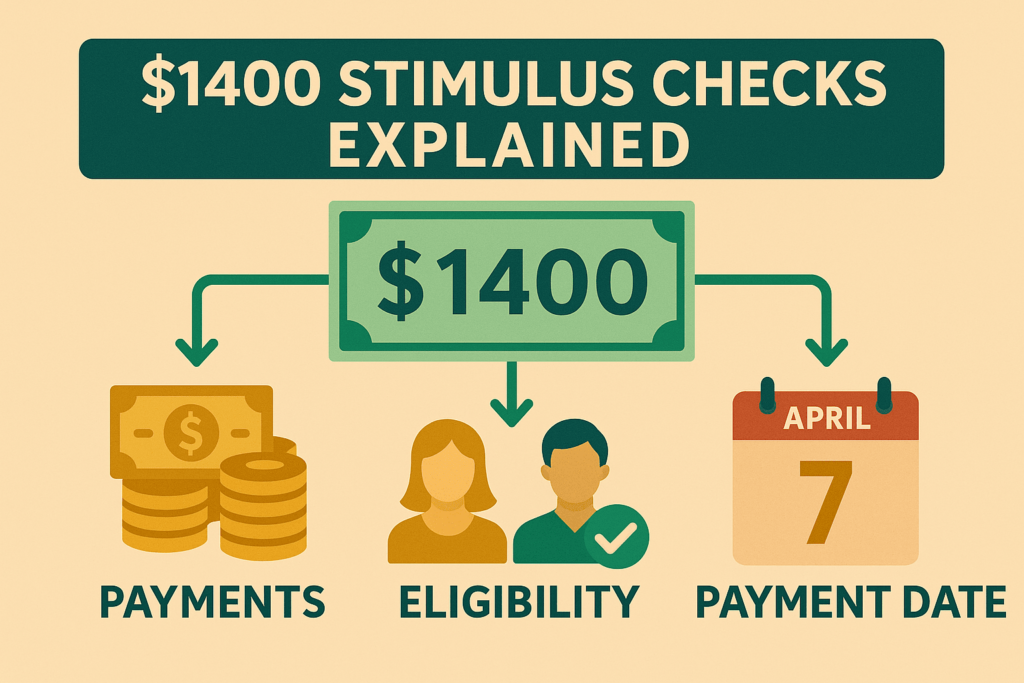
Here is how the American Rescue Plan payments worked:
- Single filers with an adjusted gross income (AGI) up to $75,000 qualified for the full $1,400 payment. AGI is your total income minus certain deductions.
- The payment shrank gradually and phased out fully at $80,000 for single filers.
- Married couples filing jointly could receive up to $2,800.
- Families got another $1,400 for each qualifying dependent with a valid Social Security Number.
The goal was to steer aid to low- and middle-income households. These families are more likely to spend the money quickly on basics, which boosts the economy.
Dependents and Family Considerations
A big change in this round was the inclusion of adult dependents. These included college students and elderly relatives, who had been left out of earlier payments.
Households could claim $1,400 for each dependent. This gave more help to families with several generations under one roof and to caregivers.
A Jain Family Institute analysis found that 78% of Americans backed a third payment of this size. That shows strong public support for broad relief.
Claiming Process and Deadlines
Most eligible people got their payments automatically. But those who did not file a 2021 tax return risked missing out.
To catch missed payments, the IRS offered the Recovery Rebate Credit on 2021 tax returns. The final deadline to file and claim it was April 15, 2025. That deadline has now passed.
Before the deadline, more than $1 billion in 2021 stimulus money was still unclaimed by about 1.1 million people. Money not claimed by April 15, 2025, now stays with the U.S. Treasury. As of November 2026, there is no longer any way to claim the $1,400 payment through a 2021 return.
IRS Automation and Outreach
Claiming the credit could be confusing. So in December 2024, the IRS announced automatic payments for about one million taxpayers. These people had filed a 2021 return but had not claimed the Recovery Rebate Credit.
The IRS said these payments would total about $2.4 billion, with a maximum of $1,400 per person. People did not need to take any action. Most payments arrived by late January 2025. The IRS also mailed letters to recipients. It offered online account tools so people could track their payment status.
Household Spending Patterns
Studies show that people used stimulus payments in different ways.
A Brookings analysis found two main patterns:
- Many households saved the money or paid down debt.
- Others spent more on durable goods, such as appliances and vehicles.
On average, households spent about 22% of the payment right away. The rest helped strengthen family finances as the economy recovered. This mix of saving and spending supported two goals: a steadier economy and more secure households.
Macroeconomic Effects
The $1400 stimulus checks also helped the wider economic recovery. The Brookings Institution estimated that the American Rescue Plan boosted GDP by about 4% by the end of 2021. It added a further 2% lift in 2022. Most of this came from higher consumer spending and lower household debt.
The effect of each dollar spent changed over time. But together, direct payments, extra unemployment benefits and small business support played a key role. They helped the country avoid a deeper recession.
Public and Political Response
Most Americans favored direct payments. Polls showed high approval for the $1400 stimulus checks, especially among low- and middle-income earners.
Still, there was debate over whether the amount was enough. Some lawmakers pushed for a $2,000 payment to give more help to vulnerable people. Vox reported that progressive lawmakers, including Rep. Alexandria Ocasio-Cortez, argued that $1,400 was not enough to meet ongoing needs.
Criticisms and Concerns
Critics warned that large stimulus payments could fuel inflation. FiveThirtyEight pointed to research linking direct payments to jumps in consumer demand. This may have helped push up prices for goods and services in 2021.
A Federal Reserve Bank of San Francisco study estimated the impact of pandemic-era fiscal support, including the $1400 stimulus checks. It found this support added about three percentage points to core inflation by the end of 2021.
Even so, many economists argue that the economy could have shrunk much more without this support.
Future Outlook
No new rounds of $1400 stimulus checks have been approved. Federal pandemic relief payments have ended, and the 2021 claim deadline has passed.
In 2025 and 2026, President Trump proposed $2,000 “tariff dividend” checks funded by tariff revenue. Several related bills were introduced in Congress. However, none had become law as of 2026. In February 2026, the Supreme Court also ruled that much of the tariff program was unlawful. That made such payments far less likely.
Lessons from the 2021 payments will shape how the government responds to future crises. The challenge is to balance fast relief with long-term economic stability.
The $1400 stimulus checks were a landmark effort to give direct financial help during one of the hardest periods in recent history. The American Rescue Plan made large, broad payments. These payments supported millions of households, kept consumer spending steady and helped the economy recover faster.
There is still debate over their size and their effect on inflation. Even so, these payments show the power of direct government support in a crisis. They also set an example for future policy during economic emergencies.
Many people also turned to digital assets during this period. To learn more, read our guide on how cryptocurrency is reshaping global finance. You can also follow the latest market moves on our crypto market today page.
About the author
Mushumir Butt is a seasoned crypto journalist with over three years of experience reporting on the world of blockchain and cryptocurrency. At Blockchain Reporter, he delivers insightful news, in‐depth project reviews, and precise price analysis and predictions. With a strong background in SEO and digital marketing, Mushumir excels at breaking down complex trends into clear, accessible content, ensuring readers stay ahead in the fast‐paced crypto space.
View all articles by Mushumir Butt
Frequently Asked Questions
Who was eligible to receive the $1400 stimulus checks?
Individuals with an adjusted gross income (AGI) of up to $75,000 (or $150,000 for married couples filing jointly) were eligible for the full $1,400 payment. The amount phased out for individuals earning up to $80,000 and couples up to $160,000. Additionally, $1,400 was provided for each dependent, including adult dependents who were previously excluded.
What should I do if I never received my $1400 stimulus check?
If you were eligible but did not receive the payment, you can still claim it as a Recovery Rebate Credit by filing a 2021 federal tax return. The IRS has set a deadline of April 15, 2025, after which unclaimed payments will be forfeited.
Were the $1400 stimulus checks taxable?
No, the $1400 stimulus checks were not considered taxable income. They were classified as an advance on a 2021 tax credit, so receiving the payment had no impact on your tax liability or refunds.