

- 1. What Helius switched on, in the order the record sets it out
- 2. The audit trail is the part institutions will read first
- 3. Custom Rings: a proposal under audit, not a live product
- 4. The arithmetic behind a $50 billion market cap
- 5. Why the privacy coins are the wrong benchmark
- 6. What could change the picture
- 7. Frequently Asked Questions
Helius released Solana Privacy Rings on mainnet on November 10, adding a shielded pool in which asset amounts are encrypted, wallet addresses stay visible, and every private transfer still settles inside a single Solana transaction. The company opened the permissionless Ring to any developer through an API, with TypeScript and Rust SDKs.
SOL traded at $84.87 at 20:21 UTC on November 11, up 1.75% over 24 hours, according to CoinGecko. That price is 30.5% below the $122.08 daily close of September 26 and 11.2% below the $95.51 close of November 5. The token’s market value stood at $50.19 billion against a circulating supply of roughly 591.4 million SOL.
The interesting part for anyone allocating capital here is not the privacy claim. It is the paperwork attached to it: three named audit firms, a trusted setup shared with Zcash engineers, a formal-verification commitment due by the end of 2026, and a second product, Custom Rings, that exists only as an audited proposal with a target date. Privacy is the headline; the compliance architecture is what determines whether a fund, a payment processor or a bank can actually touch it.
What Helius switched on, in the order the record sets it out
The permissionless Ring is a programmable shielded pool. Helius describes five properties in its release: transactions require the owner’s signature, so custody stays with the user; the pool accepts SOL, SPL and Token-2022 tokens; private transactions execute directly on Solana rather than on a sidechain or sequencer; the encrypted data is stored on Solana’s ledger; and succinct zero-knowledge proofs verify private transfers in milliseconds.
The privacy guarantee is narrower than the word “privacy” suggests, and the documentation is explicit about it. In the default confidential Ring, the asset and the amount are encrypted; the sender and recipient addresses remain public. Only the holder can decrypt balances, using a viewing key. A reader who wants to know that a wallet moved funds can still see the movement. What they cannot see is how much of what.
Mert Mumtaz, Helius’s chief executive, framed the release as a scaling argument rather than an ideological one: “When people talk about adoption and scaling in crypto, they mistakenly only think about throughput and latency — but the final scaling frontier in crypto is actually privacy. Without privacy, no serious institution or individual will feel comfortable having their entire financial identity exposed to the public in perpetuity.”
That is a company claim about demand, not a measurement. What can be measured today is the integration list. Helius says Decrypt uses confidential transfers in its money account, Ore uses them in its mining and staking app, and Aurora Intents routes cross-chain assets into confidential balances. It names Backpack, DFlow, Jupiter, Squads and Titan as teams working on integrations, and Crossmint, Moonpay and Paybis as on-ramp partners in development.
The audit trail is the part institutions will read first
Three independent firms audited the core programs and the zero-knowledge circuits, according to the release: Certora, ZK Security and OtterSec. Engineers from Solana Foundation, Blueshift, Zcash, Certora, OtterSec and ZK Security performed the trusted setup for the circuits, a ceremony that matters because a compromised setup can undermine the soundness of the proofs regardless of how clean the application code is.
Formal verification of the permissionless Ring programs and circuits is still running. Helius states it expects that work to be complete by the end of 2026. Until then, the deployed system is audited but not formally verified, a distinction that procurement teams at regulated firms tend to treat as material rather than cosmetic.
The compliance vendors named in the release follow the same pattern. Range, Chainalysis and Elliptic Labs support wallet screening for flows into and out of confidential balances. That is a deliberate design choice: because addresses stay visible in the default Ring, a screening vendor can still attach a risk score to a counterparty even when the amount is hidden. A privacy coin that hides both sides of a transfer cannot offer that, which is why the two designs attract different buyers.
Custom Rings: a proposal under audit, not a live product
The second product is where the institutional money would sit, and it is not live. Custom Rings are separate Solana programs that coexist with the permissionless pool. They can run confidential, with visible counterparties and encrypted balances, or anonymous, with both counterparties and balances encrypted.
Each Custom Ring can carry an auditor key that grants read access to balances inside it under a configured policy. Users can disclose a single transaction through a transaction viewing key without opening their whole history. Institutions can enforce allowlists, blocklists, freezes and additional signature requirements onchain.
Ben Brophy, who leads institutional growth in Europe for the Solana Foundation, described the requirement in the release: “For institutions to meaningfully participate in onchain finance, privacy needs to be built into the infrastructure from the start. Businesses need to protect sensitive transaction data, counterparties, and balances without sacrificing the transparency and accountability required by their compliance frameworks.”
Helius quotes a passage from SEC Chairman Paul S. Atkins’s December 15, 2025 remarks in the same section, describing zero-knowledge proofs, selective disclosure and wallet designs that “allow users to prove compliance without handing over their entire financial history”. The citation is the company’s, not a regulator’s endorsement of this product. No SEC statement, exemptive relief or no-action letter specific to Privacy Rings appears in the release or the documentation.
The status line matters for anyone planning around it: Custom Rings “are currently being audited, and a target Solana mainnet release date is anticipated for Q4 2026”. A target date is not a delivery date, and the audit has not closed.
The arithmetic behind a $50 billion market cap
SOL’s move this week has been down, not up. The token is 11.2% below its November 5 close of $95.51 and 19.7% below the $105.64 close of October 13. Its 90-day low is $74.55, set on August 17, and its 90-day high is the $122.08 print of September 26. The current $84.87 sits 13.8% above that low and 30.5% below that high.
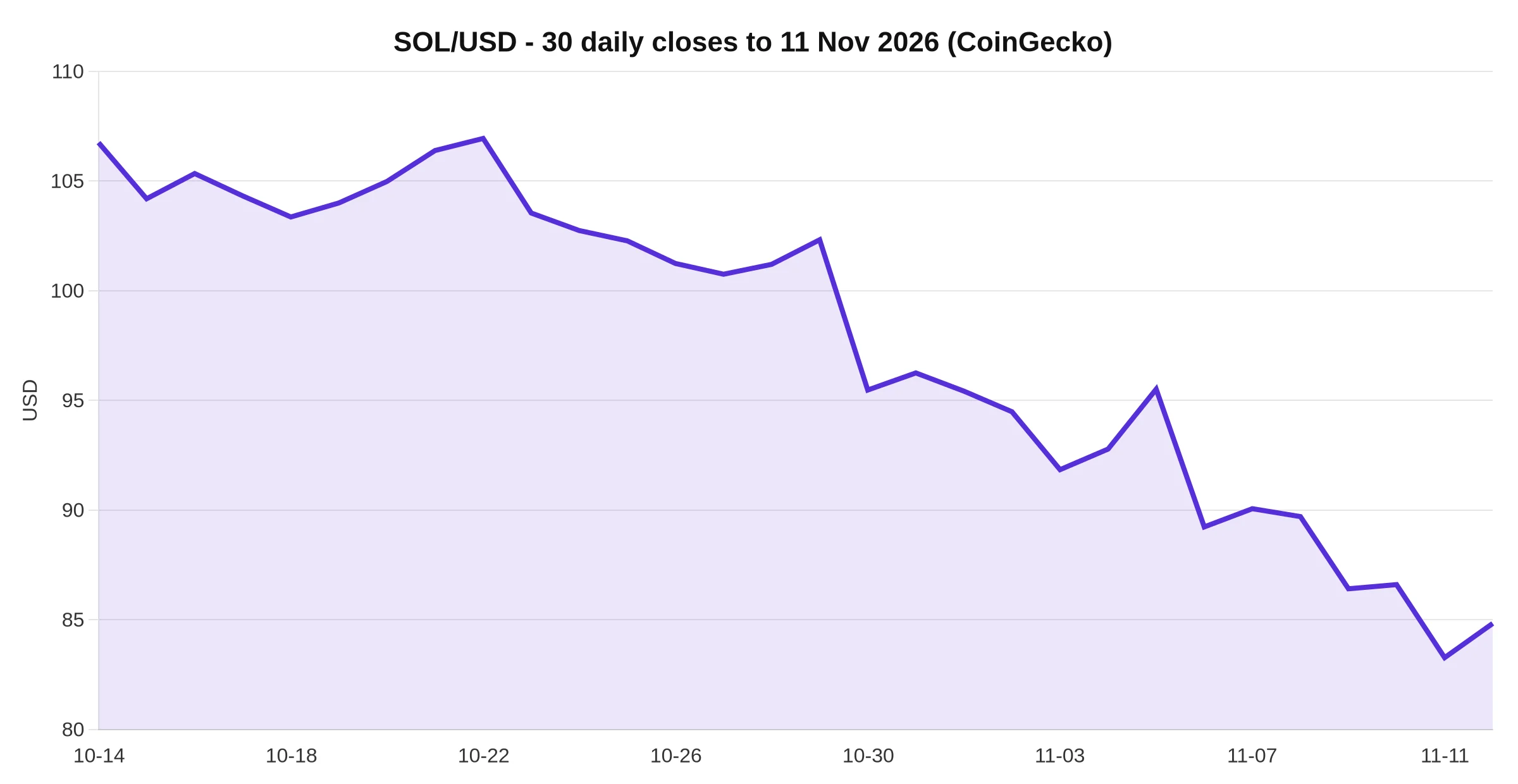
Three calculations turn those numbers into something an allocator can use. First, at roughly 591.4 million tokens outstanding, a $100 billion market value implies $169.01 per SOL. Second, matching ether’s $296.46 billion market value at the same supply would imply $501.04, about 5.9 times the current price. Third, $1,000 buys 11.78 SOL today; at $169.01 that position would be worth $1,991, and at $501.04 it would be worth $5,904.
None of those are forecasts. They are arithmetic that shows how much of the current price is a bet on multiple expansion rather than on network revenue, and they are the reason a product announcement alone rarely moves a token of this size. The same 30-day drawdown is visible in the comparison with XRP’s supply and drawdown published on November 9.
Why the privacy coins are the wrong benchmark
Zcash and Monero are the obvious comparables, and the numbers say they are an order of magnitude smaller. ZEC traded at $1,000.11 at 20:21 UTC on November 11, down 3.73% in 24 hours, with a $17.05 billion market value. XMR traded at $591.42, up 5.96%, with $11.13 billion. Combined, the two privacy assets are worth $28.18 billion, or 56.1% of SOL’s market value.
The design difference explains the valuation gap better than the privacy label does. Zcash and Monero hide the parties to a transaction as well as the amount, which is why exchange listing and regulatory treatment remain contested for both. Privacy Rings, in the default configuration, hide the amount and expose the wallet, which keeps screening vendors in the loop. The Zcash and Monero comparison from November 8 tracked ZEC at $1,260; it has since lost about a fifth of that level, a move that coincided with a broader risk-asset drawdown rather than any privacy-specific event the record identifies.
What could change the picture
Three things would change the assessment, and each has a date attached. The first is formal verification closing, which Helius targets for the end of 2026; if it slips, the “audited but not verified” caveat survives into next year. The second is Custom Rings reaching mainnet, targeted for Q4 2026 after the current audit; a live, auditor-keyed program is what a regulated counterparty can point to in a procurement review.
The third is adoption that shows up in balances rather than in partnership lists. Integration announcements from Backpack, DFlow, Jupiter, Squads and Titan are intentions until private balances carry volume that can be observed. Helius does not publish a measure of shielded value in the release or the documentation, so the size of the pool cannot currently be verified from the primary source.
On price, the reference levels are the ones already quoted: a daily close back above $95.51 would retake the November 5 level, and a close below $74.55 would put SOL at its lowest daily close since the window began on August 14. Each level is a CoinGecko daily close, not a drawn trendline, and neither carries any claim about what happens next.
Data: CoinGecko, Helius release, Helius documentation.
Frequently Asked Questions
What are Solana Privacy Rings?
They are a shielded pool released on Solana mainnet by Helius on November 10, 2026. Deposits, private transfers and withdrawals execute as normal Solana transactions, but the asset and amount are encrypted and only the holder can decrypt balances with a viewing key.
Do Privacy Rings hide my wallet address?
Not in the default permissionless Ring. Sender and recipient addresses stay public while the asset and amount are encrypted. Custom Rings, which are still under audit, can run in an anonymous mode that hides counterparties as well.
When do Custom Rings launch on mainnet?
Helius says Custom Rings are currently being audited and that a mainnet release is anticipated in the fourth quarter of 2026. That is a target, not a commitment, and the audit has not been reported as complete.
How much does SOL cost right now?
SOL traded at $84.87 at 20:21 UTC on November 11, 2026, up 1.75% over 24 hours, per CoinGecko. Its market value was $50.19 billion against a circulating supply of about 591.4 million tokens.
Who audited the Privacy Rings code?
Certora, ZK Security and OtterSec audited the core programs and the zero-knowledge circuits. Engineers from Solana Foundation, Blueshift, Zcash, Certora, OtterSec and ZK Security ran the trusted setup, and formal verification is expected to finish by the end of 2026.
This article is not intended as financial advice. Educational purposes only. Prices cited are CoinGecko quotes taken at 20:21 UTC on November 11, 2026 and will change.