

Bitcoin traded a $2,551 band in 24 hours, from a $58,319 low to $60,870, and sat near $60,587 on Sunday evening. The move had a story attached to it: unverified claims that AI labs had broken modern encryption.
What actually exists as of Nov. 29 is smaller and stranger than the headlines. A group of 21 cryptographers has published a website and a membership list, and has left its first statement unpublished.
The Cryptography Incident Review Group, or CIRG, describes itself in two sentences: “The CIRG is a group of cryptographers aiming to review and help navigate cryptanalytic advances.” It adds: “We advise on how to disclose a break, communicate with those affected, and plan for cryptographic resilience.”
Its statements page carries a link titled “Forthcoming statement” and a line underneath that reads, plainly, “This statement has not been published yet.” That is the whole verified record. No paper, no proof, no named primitive, no vendor advisory, and no confirmation that RSA, ECDSA, or any deployed system has fallen.
The market moved anyway. This is what the evidence supports, what it does not, and what a trader or wallet holder should watch next.
What CIRG Is, and What It Has Not Said Yet
CIRG is not a standards body and it has no enforcement power. It is a volunteer panel assembled to do something the field has never had at speed: a shared channel for reviewing claims of a cryptanalytic break before those claims are either dismissed or repeated into a market panic.
Its site lists 21 members, all serving “in a personal capacity,” with affiliations “listed for identification only.” Fifteen of the 21 list a US institution as their primary affiliation. The rest are spread across Singapore, Switzerland, Germany, France and Israel.
That distribution matters less than the overlap of specialties: integer factorisation, lattice cryptography, elliptic curves, zero-knowledge proof systems, and complexity theory all sit on the same list.
Alexander May of Ruhr University Bochum works on factoring. Nadia Heninger of UC San Diego and Inria Saclay works on the failure modes of deployed public-key cryptography. Vadim Lyubashevsky of IBM Research and Chris Peikert of Michigan work on lattice schemes, the family most post-quantum migration plans lean on.
Matthew Green of Johns Hopkins has spent a decade explaining why broken cryptography usually breaks in implementation, not in theory. If a lab were sitting on a genuine break, this is close to the panel you would want reading it first. It is also the panel that would refuse to sign a statement it could not verify. Both facts cut against the panic narrative.
The 21 Names Behind the Review Group
The full membership, as published by CIRG on Nov. 29:
- Divesh Aggarwal, National University of Singapore
- Dan Boneh, Stanford University
- Alessandro Chiesa, EPFL
- Giacomo Fenzi, EPFL
- Matthew Green, Johns Hopkins University
- Nadia Heninger, UC San Diego and Inria Saclay
- Aayush Jain, Carnegie Mellon University
- Yael Tauman Kalai, MIT
- Huijia (Rachel) Lin, University of Washington
- Vadim Lyubashevsky, IBM Research
- Alexander May, Ruhr University Bochum
- Daniele Micciancio, UC San Diego
- Phong Nguyen, Inria Paris and ENS/PSL
- Chris Peikert, University of Michigan
- Jonathan Rouach, QEDIT and ZKProof.org
- Noah Stephens-Davidowitz, Cornell University
- Stefano Tessaro, University of Washington
- Justin Thaler, Georgetown University and a16z
- Eran Tromer, Boston University
- Vinod Vaikuntanathan, MIT, RESI and Duality Technologies
- Ryan Williams, MIT
Read that list as an entity map rather than a headline. Three MIT faculty, two at the University of Washington, two at UC San Diego, two at EPFL. When a group with this profile says nothing, the silence is not an oversight.
It is the disclosure process working in the only order that makes sense: verify, then speak.
What Aaronson Said, and What He Refused to Say
The rumor’s most-cited origin is a blog. On Nov. 25, Scott Aaronson, a complexity theorist, published a post describing a wave of AI-produced proofs of long-open problems in mathematics and computer science.
He wrote that he was “virtually certain, from multiple reliable sources, that the AI labs are now sitting on one or more bombshells” in cryptanalysis. He added immediately: “However, until I either see details or hear directly from someone at a lab, I feel much, much less confident about the specific nature of those bombshells. I do not wish to be responsible for spreading unverified rumors.”
Two days later, in a second post on the same blog, written as a mock phone interview with a fictional financial newsletter, he restated the position in one line: “I have specific information that the labs will soon release a major breakthrough in theoretical cryptanalysis—which breakthrough, however, will not lead to imminent danger for any currently deployed cryptosystems.”
He also drew the line that most of the amplification erased. “I’ve heard endless rumors and speculations about what else the labs might have, including breaks that would cause imminent danger if they were real. And I’m forced to take such rumors seriously… But I don’t have any specific, actionable information there.”
That is the entire factual spine of a story that moved a trillion-dollar asset. A researcher with strong sourcing on a theoretical result, explicit that he cannot characterise it, explicit that he will not vouch for the dangerous version, and explicit that he does not want to be the vector for it. Everything past that point was telephone.
Why an RSA Break Would Not Be a Bitcoin Break
Most of the weekend chatter collapsed two different hard problems into one word, “encryption.” They are not the same problem, and the difference decides whether a Bitcoin holder has anything to act on.
RSA’s security rests on integer factorisation: given a large number that is the product of two primes, recover the primes. Bitcoin does not use RSA. A Bitcoin key is an elliptic-curve key on secp256k1, and a signature is ECDSA over that curve. Its security rests on the elliptic-curve discrete logarithm problem: given a point on the curve, recover the scalar that produced it.
No classical algorithm known today transfers between the two. A faster factoring method tells you nothing about discrete logs on a 256-bit curve, and the reverse is also true. This is why the field tracks them separately, and why “RSA-2048 may be in trouble” and “Bitcoin is in trouble” are different sentences that were merged into one over the weekend.
There is one place where the two converge: a large, fault-tolerant quantum computer running Shor’s algorithm breaks both. That is a planning problem measured in years, not hours.
It is the reason Ethereum’s post-quantum migration already has three named deadlines and why the industry’s signature debate has been running for months. The weekend’s rumor was about classical cryptanalysis assisted by AI, which is a different threat model with a different timeline.
This is also not the first scare of its kind. In October, Justin Drake warned that AI could break Bitcoin and Ether wallet signatures within months. No break followed, and no deployed curve changed.
The Tape Moved First: $58,319 to $60,587
Bitcoin’s session tells you what the market did with an unverified claim. It sold, then it bought back.
The 24-hour range ran from $58,319 to $60,870, a spread of 4.4% of the low, and the last print shortly after 19:10 UTC on Nov. 29 was $60,587, up 2.25% on the day, per CoinGecko.
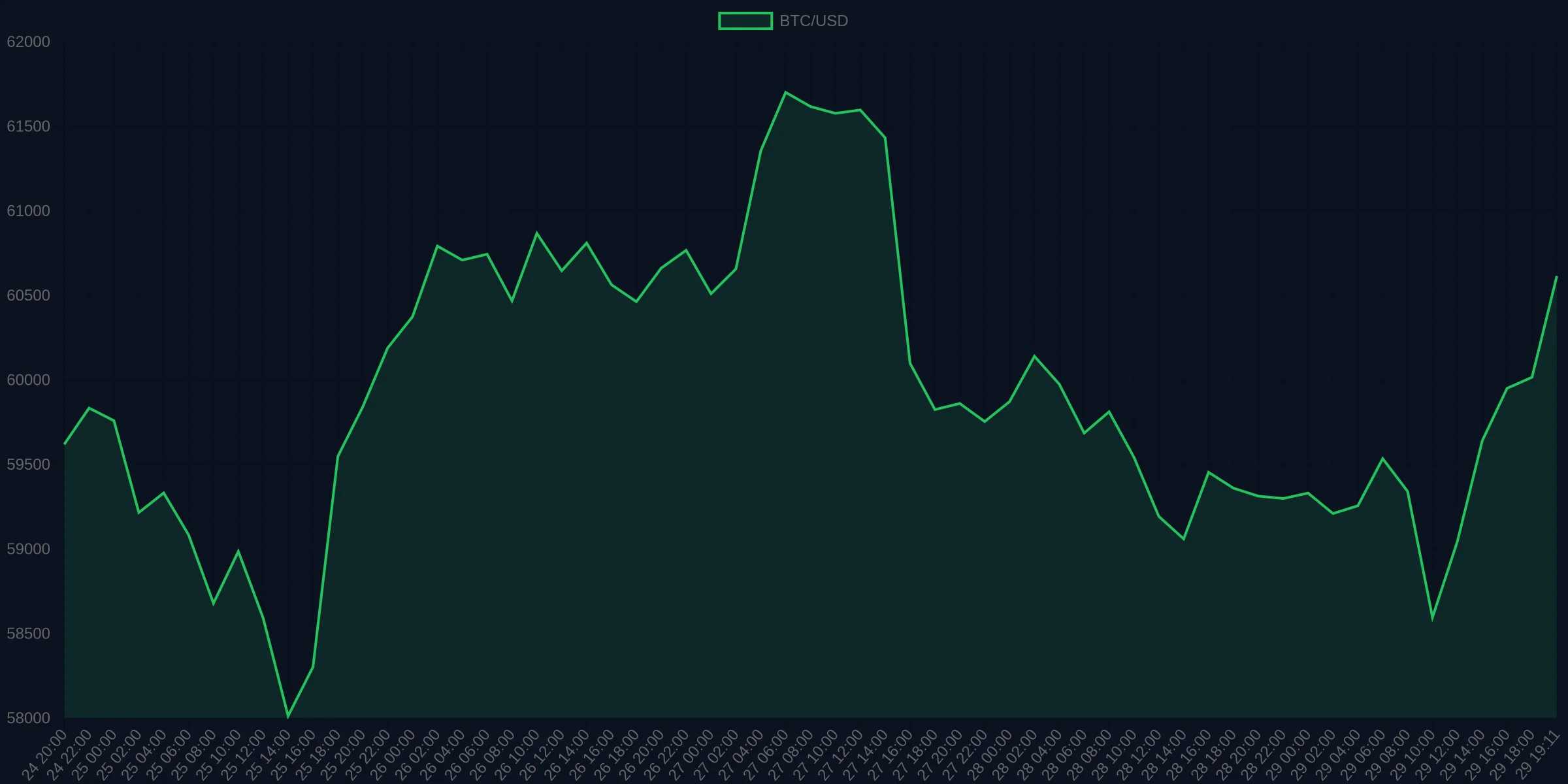
BTC/USD, hourly close, Nov. 24 20:00 to Nov. 29 19:10 UTC. Source: CoinGecko. Compiled by BlockchainReporter.
From the Nov. 24 daily close of $61,228, the weekend low marked a 4.75% drawdown. The recovery from that low is 3.89%. Bitcoin remains 51.96% below its record of $126,080 and carries a market value of about $1.22 trillion.
Ether traded at $1,670.66, up 1.61%, with a 24-hour range of $1,605 to $1,674. Solana was $72.53, up 3.04%. The majors bounced together, in the same hour, with no divergence that would suggest the market had priced a specific cryptographic failure in one chain rather than a general risk-off flush.
What the tape does not show is a break. A chain whose signatures had failed would not produce a 3.9% bounce; it would produce withdrawals, halted bridges, and emergency key rotations.
Available evidence does not establish that the rumor caused the drop. It coincided with a market already down 21.9% since Nov. 1 and trading below its 200-day average of about $71,600, both calculated from the same CoinGecko series. On that tape, a scary headline is fuel, not cause.
What Would Count as Proof
The useful discipline here is to define, in advance, what would settle the question. Five things would, and none of them is a tweet.
A paper with a reproducible attack, posted to a venue or repository where the claim can be checked line by line. A machine-checkable proof, the way the recent AI mathematics results shipped with Lean certificates. A CIRG statement that names the primitive and the parameter sizes affected.
A vendor advisory from an issuer or custodian with keys in scope. On-chain evidence that a live key was actually spent by someone who did not own it.
Until one of those appears, the correct description of the situation is: a credible researcher has heard that a theoretical result is coming, he says it does not threaten deployed systems, and 21 cryptographers have organised to check the claim. Nothing in that sequence is a demonstrated break.
The next concrete signal is CIRG’s first statement, which its site lists but has not published. The one after that is whether any lab releases a paper that survives review. Bitcoin’s own risk register does not change on either, because its exposure runs through secp256k1, and the weekend’s rumor ran through RSA.
Frequently Asked Questions
Did AI break encryption in November 2026?
No verified break has been published. A 21-member Cryptography Incident Review Group formed on Nov. 29, but its first statement is listed as not yet published, and no paper, proof, or vendor advisory confirming a break has appeared.
Is Bitcoin’s cryptography the same as RSA?
No. RSA depends on the difficulty of factoring large integers. Bitcoin uses ECDSA over the secp256k1 curve, which depends on the elliptic-curve discrete logarithm problem. A factoring advance does not transfer to Bitcoin’s signatures.
Why did Bitcoin fall to $58,319 over the weekend?
Bitcoin traded a $58,319 to $60,870 range and recovered to about $60,587. The drop coincided with unverified claims about AI-driven cryptanalysis, but available evidence does not establish the rumor as the cause; the market was already down more than 20% in November with record ETF outflows.
What would a real encryption break mean for Bitcoin holders?
It would depend entirely on which primitive broke. A factoring result would hit RSA-based systems such as TLS and legacy signing infrastructure. Bitcoin keys would only be at risk from a break in elliptic-curve discrete logs, which no published classical attack has achieved.
When will CIRG publish its first statement?
CIRG has not given a date. Its site lists a single “Forthcoming statement” entry that currently reads “This statement has not been published yet.”
Disclosure: This article does not represent investment advice. The content and materials featured on this page are for educational purposes only.