

AMD is heading into one of its biggest weeks of the year. Its Advancing AI 2026 conference runs July 22-23. AMD is expected to show its next AI infrastructure products. These include the commercial launch of its Zen 6 EPYC “Venice” server chips and new details on Helios, its rack-scale AI platform.
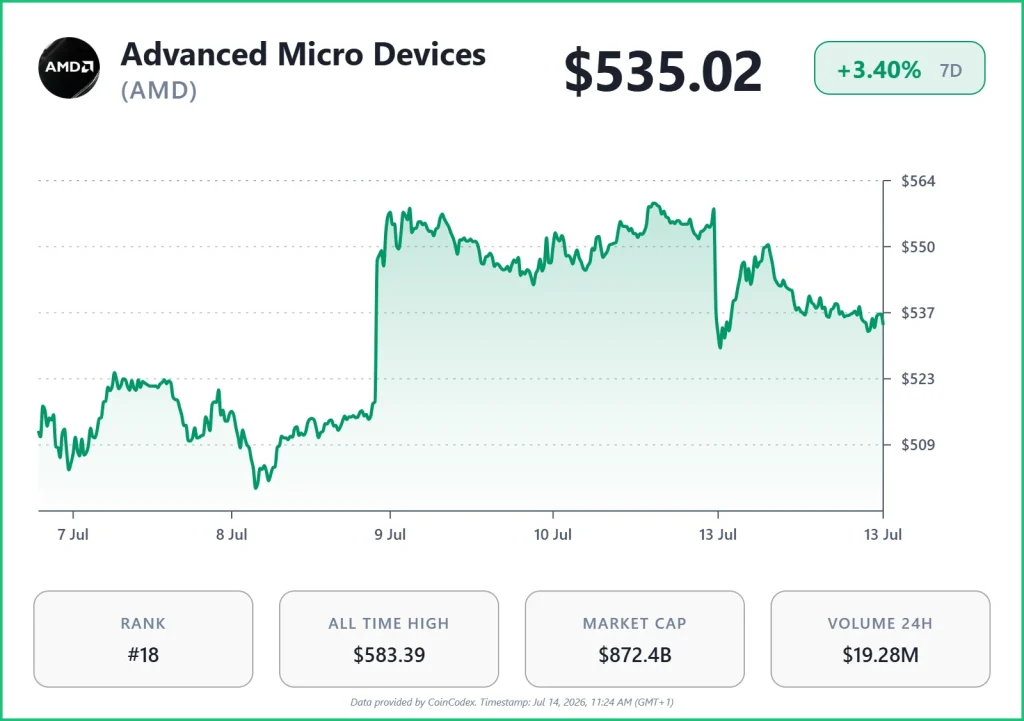
AMD shares trade near $535. Investors want to see if the event can push the stock higher again. Several banks have lifted their price targets above $600. CoinCodex expects AMD could trade above $630 by mid-2027 after a quiet period. Chart watchers see $557.70 as the next big hurdle. A break above it could open a move toward $584.
Advancing AI 2026 Could Be AMD’s Biggest Catalyst of the Year
AMD’s Advancing AI conference is now the company’s most awaited event of 2026.
The main event will be the rollout of Zen 6 EPYC “Venice”. It is AMD’s next server chip, made on TSMC’s advanced 2-nanometer process. AMD says Venice is up to 1.7 times faster than the last generation. That helps AMD in the fast-growing data center market.
Investors also expect news on Helios. It is AMD’s rack-scale AI platform. It combines EPYC processors, MI455X accelerators, fast networking, and large HBM memory into one complete AI system.
The event could matter even more if AMD names new large cloud customers. Meta has already agreed to deploy Helios in the second half of 2026. More deals would back AMD’s plan to compete head-on with Nvidia in AI infrastructure for business.
Wall Street Remains Bullish Ahead of Earnings
Analysts are still positive after AMD’s strong run over the past year. Stifel raised its price target to $635. Goldman Sachs kept a $640 target, and Bernstein still expects $600. Much of this hope rests on another strong report when AMD posts second-quarter results on August 4.
AMD expects about $11.2 billion in second-quarter revenue. That would be roughly 46% growth from a year ago, with gross margins near 56%. These numbers suggest AMD’s AI business keeps growing while staying profitable.
Some big investors have taken profits after the strong run. Still, most analysts see AMD as Nvidia’s top rival in AI infrastructure. They point to its growing range of EPYC server chips, Instinct GPUs, its ROCm software, and complete AI systems.
Technical Outlook Keeps $584 in Focus
On the charts, AMD is still in a wider uptrend, even after its recent pause.
The stock stays well above its main support zone between $501.50 and $529. It also holds well above its 200-period exponential moving average. Momentum is balanced, with the Relative Strength Index near neutral. That suggests buyers keep stepping in on dips instead of selling hard.
The key level to watch is $557.70. A daily close above it could lead to a breakout toward the next target near $584. More gains could follow if momentum builds after the Advancing AI event or the next earnings report.
On the downside, a lasting move below $501.50 would weaken the uptrend. It would also raise the odds of a deeper pullback.
CoinCodex AMD Price Prediction
The latest CoinCodex AMD price prediction expects a quiet period first. After that, it sees a stronger climb during 2027.
The model expects fairly steady trading in the second half of 2026. Average prices mostly stay between $520 and $555. July looks like the strongest month. Some mild weakness is expected from October to January as the stock slips back from summer levels.
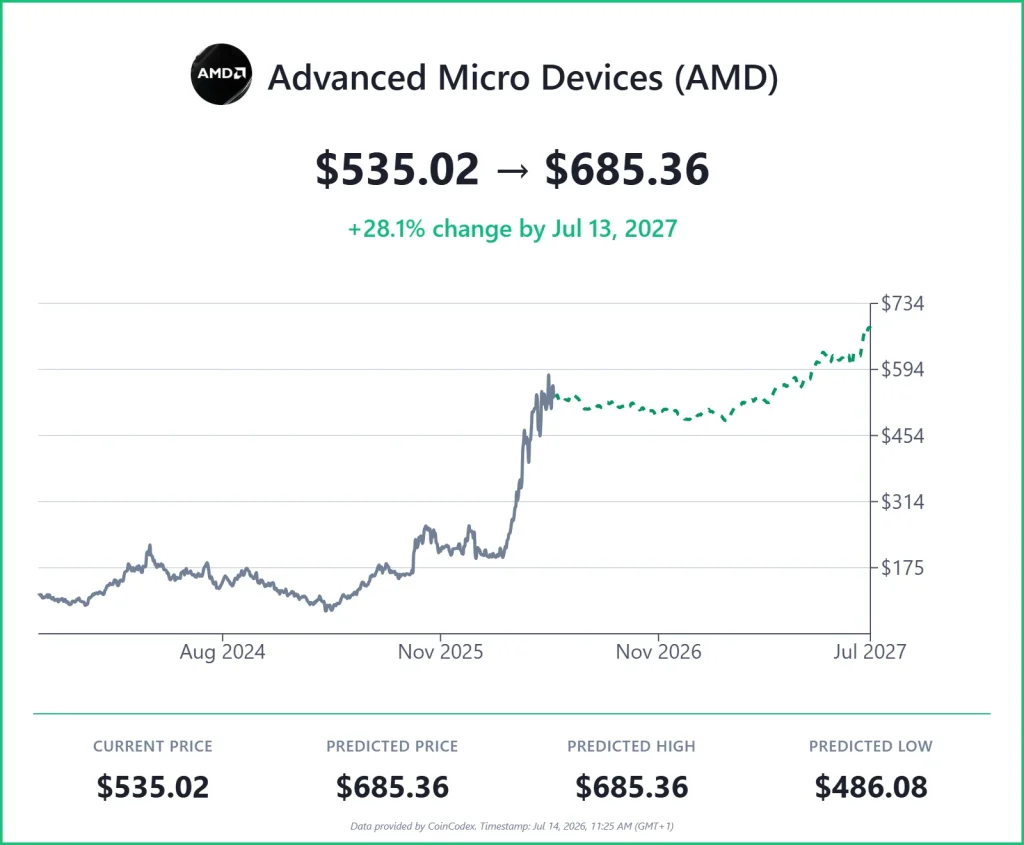
Momentum is expected to pick up again in early 2027. Average prices climb steadily through February, March, and April, then speed up in late spring. By May and June, AMD is expected to trade well above $630 on average. That would reflect better market mood and ongoing faith in AI-driven earnings.
The strongest point comes in July 2027. CoinCodex sees AMD reaching highs near $710 then, the most bullish stretch of the forecast. The model does not expect a straight climb. It sees a long pause first, then new gains, if AI spending and company earnings keep growing.
About the author
Simeon Poljakov is a crypto editor and writer. He covers bitcoin, crypto markets and blockchain news, and writes practical guides on buying, storing and cashing out crypto. His work is built on primary sources: published fees, official filings and on-chain data, with every figure checked before publication.