Blockchain News

Smart contracts, dApps, and the rise of cryptocurrencies like Bitcoin, Ethereum, Polkadot, Cardano, and more have spawned a new breed of use cases and services that run on public and private blockchains.

This new era of technology has taken the world by surprise, offering businesses, regulators, and ordinary users a chance to explore uncharted territories. A blockchain is a digital database distributed across a network of special computers called nodes. These nodes have a copy of the database and can seamlessly communicate. Anyone can join the network as a node operator and view the ledger’s contents. In essence, a blockchain is a digital ledger that records and stores data, which can be seen and accessed by everyone in the network in real-time. This distributed model assures the trustworthiness of the data because it’s impossible for one party to alter the data without the knowledge of other node operators, typically incentivized to keep the veracity of transactions.

How a Blockchain Works

Blockchain works by creating a network of computers that maintain a shared database. When a new piece of data, called a “block”, is created, it’s surrounded by a mathematical “hash” that makes it unique to that point in the network. Only the network can verify the data’s accuracy if a block of transactions is needed. This verification mechanism is the “hash”. It helps “chaining” the new block with the longer block of verified transactions, forming a blockchain. Once a block is “chained”, it is impossible to reverse posted transactions. This is why all blockchain transactions in a public database are considered immutable. Notably, any alterations in the block’s content would produce a different hash, alerting the network that data has been tampered with and is invalid. Its database will constantly grow as long as the network finds use and new blocks are added.

Blockchain Use Cases

Blockchain provides a secure and transparent platform for executing smart contracts. Smart contracts are pieces of code that automatically trigger when certain conditions are met. This minimizes the risk of fraud and reduces the cost of contracting. A blockchain can find application in regulatory compliance where it can find immense use in tracking assets, managing key processes, and auditing transactions. Furthermore, a blockchain can be used for storing data. As observed, publicly distributed blockchains provide a more efficient and secure way to store data. Stored data are openly and transparently accessible to all users. The blockchain can also find use in creating decentralized identity management systems. In this arrangement, the ledger can authenticate users, manage access to applications and store personal data. When integrated with an identity management system, the blockchain can be further used to keep data private. Data cannot be accessed or altered by third parties or organizations. At the same time, the blockchain can be used efficiently in supply chain management, where the technology can drastically improve logistics. Ordinarily, supply chains are complex and have many variables that make tracking challenging to use in traditional systems. This could make blockchain an appealing alternative.
Nine US Companies Block Tokenized Stock Trading on OKXICE

Nine U.S.-listed companies have filed objections blocking tokenized versions of their shares from trading on OKXICE, the venue run by ICE and OKX.

October 18, 2026
What Is the Quantum Alliance? Nine Blockchain Firms Set Post-Quantum Standards

Nine blockchain organizations formed the Quantum Alliance to publish open standards for judging whether a crypto network is ready for quantum computers.

October 17, 2026
Are NIST Elliptic Curves Backdoored? Claude Solves the 25-Year Seed Mystery

Anthropic says Claude found that NIST’s curve seeds came from a 1990s random number generator seeded with Unix timestamps, not a hidden backdoor.

October 17, 2026
Judge Refuses to Erase Gemini’s $5 Million CFTC Settlement

Judge Alvin Hellerstein rejected a joint Gemini-CFTC request to erase the exchange’s $5 million settlement, keeping the penalty and injunction intact.

October 17, 2026
Cobo to Shut Down Retail Wallet App in December, Charging 2% Monthly on Remaining Funds

Cobo’s retail wallet app shuts down on December 1, and any balances not withdrawn in time will be charged a 2% monthly fee with a $100 minimum.

October 17, 2026
SBI and Startale Join Open Standard to Pilot Yen-Dollar Stablecoin Settlement

SBI Holdings and Startale Group joined the Open Standard alliance behind the OUSD dollar stablecoin and will pilot linking it with the yen-denominated JPYSC.

October 17, 2026
Fission Raises $10M Series A Led by Pantera Capital for Tokenized Fund Liquidity

The tokenization startup adds Circle Ventures, Borderless Capital and other investors as it expands liquidity for on-chain investment funds.

October 16, 2026
What Are Stablecoin Cards? Coinbase and Marqeta Expand Enterprise Payments

Marqeta is extending its Coinbase relationship so businesses can issue cards that let customers spend stablecoin balances at millions of merchants.

October 16, 2026
RedotPay Co-Founder Speaks on Stablecoin Payments and Global Expansion

JC explains how RedotPay advaces stablecoin payments, global transfers, financial inclusion, and secure crypto spending through regulated payment solutions.

By Dan K
October 16, 2026
Ledger Unveils Atom, an $899 Security Device That Runs Everyday Apps Alongside a Hardware Wallet

Ledger’s Atom is an $899 Android-based security device that runs everyday apps while signing crypto and AI agent approvals in a hardware-protected mode.

October 15, 2026
XDC Network Selects Concordium as Exclusive Identity Verification Layer for AI Agents

XDC AI has integrated Concordium’s identity verification layer, enabling AI agents to make USDC payments with accountable owners and private personal data.

By Simeon
October 15, 2026
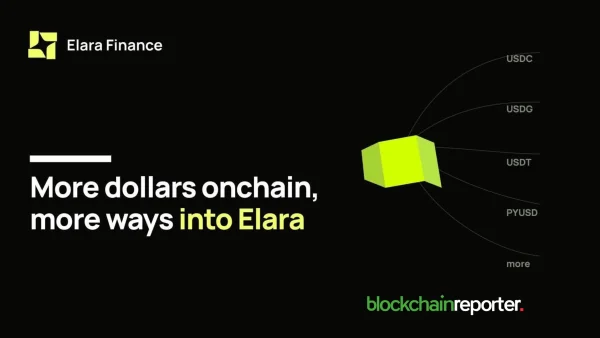
More Dollars Onchain, More Ways Into Elara

Elara expands stablecoin yield access as U.S. regulatory shifts and new integrations open more onchain markets, wallets and liquidity opportunities.

By Simeon
October 15, 2026