


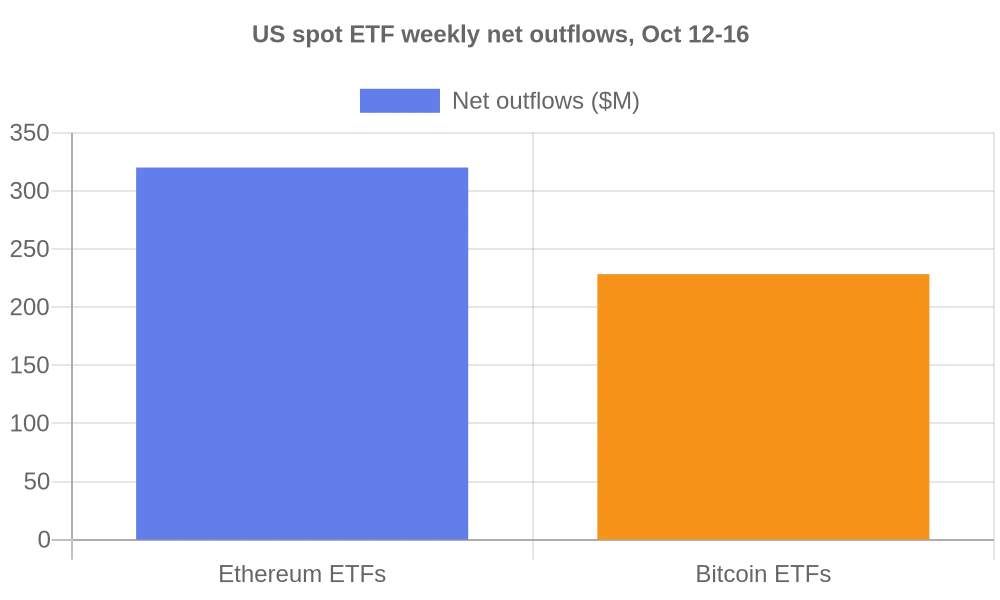
U.S. spot Ethereum ETFs are losing money faster than their Bitcoin counterparts, and the widening gap is now the clearest signal in the crypto fund market. In the trading week of October 12–16, Ethereum funds posted $320.1 million in net outflows against $228.4 million from Bitcoin funds, according to Farside Investors’ daily flow records — a $91.7 million divergence that extends Ethereum’s losing streak to a third consecutive week and pushes its October withdrawals toward $1 billion.
The concentration is the story
The outflow is not evenly spread — it is dominated by a single fund. BlackRock’s iShares Ethereum Trust (ETHA) accounted for $299 million of the category’s $320.1 million weekly outflow, or 93.4% of the total, per Farside data. Fidelity’s Ethereum fund was the lone bright spot, taking in $10.5 million, while Grayscale’s Ethereum Trust and its Mini Trust shed $18.3 million and $12.4 million respectively.
On the Bitcoin side the pain was shallower and spread across more names. BlackRock’s iShares Bitcoin Trust lost $165.4 million and Fidelity’s FBTC $60.2 million, as SoSoValue’s tracker shows. But the week’s sharpest single session belonged to Bitcoin: on Wednesday, $261.4 million left Bitcoin products in one trading day — a larger single-day withdrawal than the category’s entire five-day net total.
The macro trigger lines up with the heaviest day
The Wednesday blowout did not happen in a vacuum. September CPI printed 3.7% against a 3.6% forecast that same day, according to U.S. data released Wednesday. The hotter-than-expected inflation read arrived in the same session Bitcoin ETFs recorded their largest withdrawal of the week, and it also triggered roughly $106 million in Ethereum long-position liquidations within a single hour, per CoinGlass data. The liquidations are a derivatives event — separate from spot ETF redemptions — but they mark the same macro-driven de-risking.
Why Ethereum is bleeding faster than Bitcoin
Four forces explain the asymmetry. First, concentration: a single product — ETHA — is behind nearly all of Ethereum’s outflow, so a few large institutional redemptions move the entire category’s number. Bitcoin’s outflows are distributed across IBIT, FBTC and smaller funds, which reads more like broad trimming than a targeted exit.
Second, relative price. Ethereum fell roughly 5% over the seven-day stretch to around $2,433, while Bitcoin dipped only 1.3% to about $82,783, per CoinGecko’s Ethereum and Bitcoin price data. When the macro picture turns, the weaker performer is the first asset trimmed from a portfolio — and Ethereum has been the weaker performer all quarter.
Third, positioning ahead of a known catalyst. Ethereum’s Q4 network upgrade — the Glamsterdam/Hoodi upgrade aimed at improving speed and capacity — is scheduled and public, which makes it a tradeable event. Some institutional money is de-risking ahead of the upgrade rather than holding through it: a “sell the event” posture that shows up as redemptions now and only reverses if the upgrade lands cleanly.
Fourth, and most structural, is the staking gap. U.S. spot Ethereum ETFs do not pass through staking rewards, while holders who stake ETH directly earn a yield on the asset. An institution that wants Ethereum exposure plus that return has a reason to hold the asset outside the wrapper — a trade-off Bitcoin funds simply do not face, because Bitcoin carries no native yield. That asymmetry means Ethereum ETFs begin every risk-off episode from a structural disadvantage, which helps explain why their outflows run deeper and last longer than Bitcoinu2019s.
Analysts read the flows as tactical, not structural
Charles Schwab’s equity research director Adam Lynch frames the withdrawals as “tactical institutional trading” rather than weakening long-term demand — institutions using the funds for liquidity and cost efficiency while they reposition. He points to regulatory progress and Ethereum’s Q4 network upgrade as the catalysts that could reverse the flow.
Grayscale’s head of research, Zach Pandl, is more explicitly constructive on the overlooked names. He argues Bitcoin bottomed near $58,000 in June, that demand for scarce assets remains supported by fiscal deficits and currency debasement, and that Ethereum, Solana and BNB Chain are the overlooked opportunities as institutional adoption of stablecoins, tokenized deposits and real-world assets accelerates.
What the outflows do not mean
The redemptions are not a verdict on the ETF structure. Both Bitcoin and Ethereum funds remain in positive territory for 2026 — Bitcoin ETFs have drawn roughly $259 million net year-to-date and Ethereum funds about $610 million. Net flows measure share creation and redemption, not the market value of existing assets; a fund can post redemptions while its asset base stays large. This is a lighter version of the same pattern we flagged when Bitcoin ETFs lost $2 billion in a single week — the vehicle is not the problem, the positioning is.
Nor do the flows establish that the burn is over. VanEck asked the SEC on October 14 to withdraw its proposed Lido staked Ethereum ETF registration, a quiet signal that the staked-ETH product pipeline is cooling while the macro picture stays uncertain.
The wider fund market is under the same pressure
The Ethereum-Bitcoin divergence sits inside a broader risk-off across the fund complex. Solana products lost $25.5 million over the week, with every session negative, Zcash’s tracked fund shed $19.2 million, and Hyperliquid products gave up $17.5 million, according to SoSoValue data. XRP was the lone exception among the majors: XRP funds took in a modest $740,414 on the week’s heaviest outflow day, the only positive reading in the group. That rotation — out of Bitcoin and Ethereum into a single altcoin name — is the kind of tactical churn Lynch describes, and it does not yet read as a durable commitment to any one asset.
The concentration risk runs both ways. Just as ETHA’s redemptions dominate the Ethereum category, the recovery story hinges on the same fund: if BlackRock’s iShares Ethereum Trust stops bleeding, the category’s weekly number flips positive almost on its own. That is why the 93.4% share matters more than the $299 million headline — it means the Ethereum ETF story is, for now, a single-fund story.
What to watch next
The signal to track is not the weekly total but the sequence. Ethereum funds recorded a single positive day last week — Tuesday. A second positive session would be the first sign the “sell the upgrade” trade is unwinding. Beyond that: the upgrade timeline itself, the next inflation print and the Fed’s response, and whether BlackRock’s ETHA redemptions slow from their current 93% share of the category’s outflow.
In the meantime, the Ethereum-Bitcoin outflow gap is best read as a positioning signal, not a conclusion. Track the weekly picture in our ETF coverage and the broader Ethereum hub. Institutions are using the most liquid vehicles available to de-risk ahead of a known catalyst and an uncertain macro backdrop — and Ethereum, the weaker performer, is absorbing the larger share of that trade, just as Bitcoin’s own price action has been the steadier of the two.
Disclosure: This article does not represent investment advice. The content and materials featured on this page are for educational purposes only.