

- 1. 397 days, then a two-page cancellation
- 2. What the two funds were designed to hold
- 3. The two crypto income funds Roundhill did not cancel
- 4. Why an income wrapper is the hardest product to sell in a 30% month
- 5. Where SOL and XRP actually trade
- 6. What the withdrawal does not mean
- 7. What to watch from here
- 8. Frequently Asked Questions
Roundhill ETF Trust withdrew its Solana Covered Call Strategy ETF and its XRP Covered Call Strategy ETF on 18 November 2026, eighteen days before either fund could become effective. Two Form AW requests filed with the U.S. Securities and Exchange Commission cancel Post-Effective Amendments 190 and 191 and pull every extension that had kept both funds alive since October 2025.
The letters are short and leave no room for interpretation. “The Trust no longer intends to seek effectiveness of the Fund and no securities of the Fund were sold, or will be sold,” Roundhill wrote in each filing, signed by the trust’s secretary, Sean Poyntz. Neither document states a reason. This was not an SEC rejection. It was the sponsor closing two products it had never finished building.
What the record shows is a pair of funds that never reached the point of being priced. The 17 October 2025 prospectus for the Solana vehicle was stamped “Subject to Completion”, named the fund “Roundhill Solana Covered Call Strategy ETF (_____)”, left the listing venue as a blank line, and printed the management fee as “____%” inside a unitary fee arrangement with Roundhill Financial Inc. A fund whose own prospectus cannot state its ticker, its exchange or its fee has not been cleared to sell shares, and both funds had been buying more time ever since.
397 days, then a two-page cancellation
Post-Effective Amendment 190 landed on 17 October 2025. Its automatic effectiveness was pushed back repeatedly, each time through a 485BXT filing that resets the clock. The last of those extensions, filed on 6 November 2026, moved the effective date to 6 December 2026. Amendment 191, covering the XRP fund, followed an identical path and ended at the same deadline.
The withdrawal arrived 397 days after the original amendment and 18 days before the date the SEC had granted. Roundhill also asked the regulator to withdraw “each BXT Filing”, so the extensions fall with the amendments rather than surviving them. Nothing connected to either fund remains pending on the register.
There is a practical detail buried in that paperwork. A post-effective amendment normally becomes effective on its own schedule, and an issuer that keeps filing extensions is signalling that it is not ready to launch. Roundhill filed those extensions for roughly a year. When the company finally stopped, it did not ask for more time. It cancelled.
What the two funds were designed to hold
Both products were income vehicles wrapped around another fund. The Solana prospectus set a primary objective of current income and a secondary objective of matching the price return of one or more exchange-traded funds that hold SOL or gain exposure to it through futures. Then came the structural clause: “The Fund will invest at least 80% of its net assets (plus any borrowings for investment purposes) in Solana ETF Options.”
The same page is explicit about what the fund would not own. “The Fund does not invest directly in SOL.” Every dollar of Solana exposure would arrive through call and put contracts written on Solana ETFs, and the sale of calls would cap the upside: the prospectus warns that selling call options “will potentially limit the degree to which the Fund will participate in any gains experienced by the Solana ETFs”. The XRP prospectus, filed the same day, repeats the structure word for word with XRP ETF options in place of Solana ones, and carries the same line that the fund “does not invest directly in XRP”.
That design is standard for the category. A covered call fund holds or synthesises the asset, sells calls against it, and passes the premium to shareholders as a distribution. The trade-off is fixed: the fund collects income in flat or falling markets and gives away part of the rally when the asset rises.
The two crypto income funds Roundhill did not cancel
The withdrawal is easier to read against the products Roundhill still runs. The issuer’s own fund list shows two live crypto covered call funds, both trading on Cboe BZX, both paying weekly distributions, and both with fee tables that were filled in rather than left blank.
| Fund | Structure | Venue | Gross fee | Status |
|---|---|---|---|---|
| Roundhill Bitcoin Covered Call Strategy ETF (YBTC) | Synthetic covered calls on bitcoin ETPs | Cboe BZX | 0.95% | Trading |
| Roundhill Ether Covered Call Strategy ETF (YETH) | Weekly FLEX calls on ether ETFs | Cboe BZX | 0.96% | Trading |
| Roundhill Solana Covered Call Strategy ETF | At least 80% in Solana ETF options | Blank in filing | Blank in filing | Withdrawn 18 Nov 2026 |
| Roundhill XRP Covered Call Strategy ETF | At least 80% in XRP ETF options | Blank in filing | Blank in filing | Withdrawn 18 Nov 2026 |
Roundhill describes YBTC on its website as “the first U.S. listed bitcoin covered call ETF”, and describes its ether sibling in similar terms: “YETH sells weekly FLEX call options on ether ETFs to generate income.” Both pages also carry the warning that has become routine for this product type. Per YBTC’s most recent 19a-1 notice, the estimated composition of the latest distribution is 100% return of capital, which means the income shareholders received was, at least in accounting terms, their own principal coming back.
Roundhill made no comparable progress on the SOL and XRP versions. The live funds have tickers, exchanges and published fee ratios. The two withdrawn funds had underscores.
Why an income wrapper is the hardest product to sell in a 30% month
Covered call funds earn their keep when the underlying trades sideways. The premium sold each week is sized against the asset’s implied volatility, and the fund keeps that premium whether the asset rises a little, stalls or falls a little. What breaks the arithmetic is a sustained decline large enough that four weeks of premium cannot cover it.
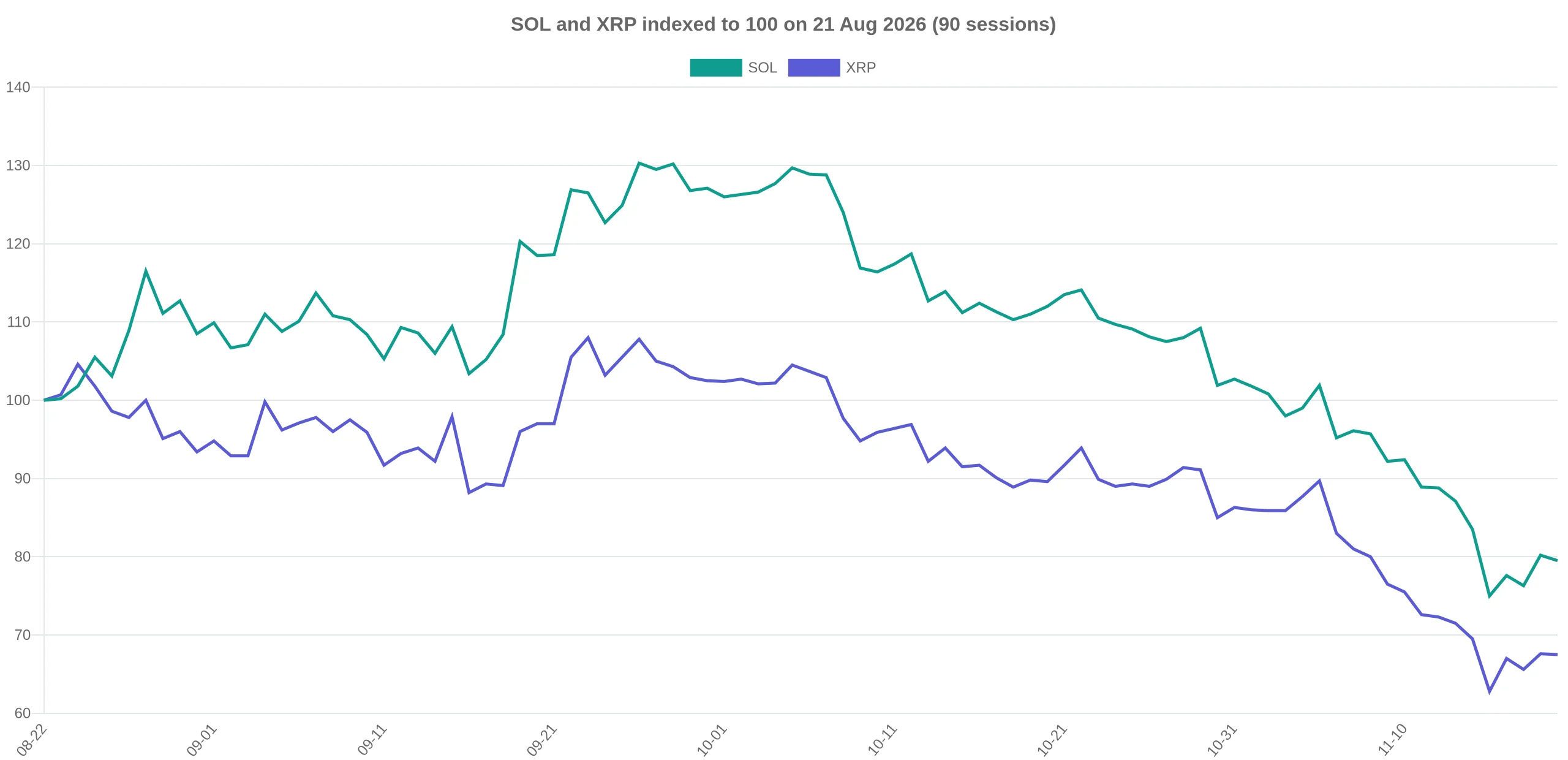
Solana fell 30.0% over the thirty sessions to 19 November, and XRP fell 26.4% over the same window, measured on CoinGecko daily closes. Spread evenly across four weekly sales, offsetting that decline would have required the funds to capture roughly 8.5% a week on SOL and 7.4% a week on XRP, before fees. Those figures are arithmetic on the price move, not a claim about premiums that were actually available in the options market. They simply show the size of the hole a capped-upside income strategy would have been asked to fill.
The longer drawdown is worse. Solana trades 74.6% below its all-time high and XRP 73.1% below its, according to CoinGecko. An investor buying an income wrapper in that tape is accepting capped upside on an asset that has been falling for a year, in exchange for a distribution that may be partly their own capital. That pitch was difficult for issuers across the category in 2026, and the filings give no indication that Roundhill found a version of it that worked for SOL or XRP.
Where SOL and XRP actually trade
Solana changed hands at $74.49 at 11:00 UTC on 19 November, down 0.29% in 24 hours and 10.13% over seven days, with a market capitalisation of $44.08 billion and $2.10 billion of turnover. Using CoinGecko daily closes from 24 April to 19 November, the 20-day average sits at $83.80, the 50-day at $98.19 and the 200-day at $88.59, which leaves spot 15.9% below its 200-day line. The 90-session range runs from $70.24 to $122.08, and the current price is 39.0% under the top of it.
XRP traded at $0.9826, down 1.76% in 24 hours and 5.63% on the week, with a $62.41 billion market cap. The same calculation puts its 20-day average at $1.101, the 50-day at $1.2588 and the 200-day at $1.2463, so spot is 21.2% below the long average. Its 90-session range is $0.9137 to $1.5713, and it sits 37.5% beneath the high. For context on how both assets got here, this site’s Solana price review from 18 November flagged $70 as the line that mattered, and the XRP close below $0.914 the day before was its lowest since November 2024.
Data: CoinGecko.
What the withdrawal does not mean
It does not mean the SEC refused a Solana or XRP ETF. A Form AW under Rule 477 is a voluntary request by the registrant, and the agency’s role here is administrative. It also does not mean spot Solana or XRP funds are shutting: the withdrawal covers two covered call wrappers that never held a dollar, and other issuers’ products are untouched by it. No investor lost access to anything, because no shares of either fund were ever sold.
Roundhill can come back. A new registration statement with a stated fee, a named exchange and a ticker would put the same strategy in front of the SEC again, and nothing in the withdrawal prevents that. The same day’s docket also included a third Form AW, cancelling Post-Effective Amendment 309 for the Roundhill Daily 2X Long LYTE ETF, a leveraged single-stock product that was due to become effective on 19 November. Three withdrawals on one day looks like housekeeping across the trust rather than a verdict on crypto.
What to watch from here
The next observable signal is a refiling. If Roundhill returns with a Solana or XRP income product, the fee and the exchange in that document will show how the company re-priced the risk. If nothing appears in the coming weeks, the withdrawal reads as an exit from the two assets rather than a delay. The 6 December effective date no longer applies to anything.
The price levels matter for the same reason. Solana’s 90-session low of $70.24 and XRP’s $0.9137 are the levels the withdrawn funds would have been defending with premium income, and a break below them would make the economics of any capped-upside product harder to argue, not easier. A recovery back above the 200-day averages at $88.59 and $1.2463 would change the pitch in the other direction. Until one of those moves happens, the market has two fewer income products to choose from and no explanation from the sponsor beyond a two-page letter.
Frequently Asked Questions
Did the SEC reject Roundhill’s Solana ETF?
No. Roundhill filed a voluntary request to withdraw the registration under Rule 477, and the SEC’s role is administrative. The filing states the trust no longer intends to seek effectiveness of the fund. That is a sponsor decision, not a regulatory rejection.
Were the Solana and XRP funds ever available to investors?
No. Neither fund became effective, neither had a ticker or a listing venue, and the filings state that no securities of either fund were sold or will be sold. There are no shareholder positions to wind down.
Does this affect spot Solana or XRP ETFs?
No. The withdrawal covers two covered call strategy funds that would have gained exposure through options on Solana and XRP ETFs. Funds that hold the assets directly, or that track them through futures, are separate registrations and are not part of these filings.
Why would an issuer cancel a fund before it launches?
The filings do not give a reason. Common explanations in the category include weak expected demand, a distribution model that does not fit the asset’s volatility, and a decision to reallocate resources to products already trading. Roundhill’s live bitcoin and ether covered call funds remain open.
How does a covered call ETF generate income?
It holds or synthesises exposure to the asset and sells call options against it. The premium from those sales is passed to shareholders, usually monthly or weekly, while the sold calls cap how much of a rally the fund can capture. When the asset falls faster than the premium accumulates, distributions can include return of capital.
About the author
Jide Idowu is a skilled freelance writer with expertise in blockchain technology, cryptocurrency, and digital finance. Known for his ability to break down complex topics into clear, engaging content, Jide crafts articles, blog posts, and analyses that resonate with both beginners and seasoned professionals. His work spans a wide range of subjects, from emerging crypto trends to in-depth explorations of blockchain innovations. With a keen eye for detail and a passion for educating readers, Jide is a reliable voice in the rapidly evolving world of digital assets.