

- 1. Three Green Tickers Inside an 11.9% Weekly Drawdown
- 2. What $1,000 Buys at 08:42 UTC
- 3. The Turnover Gap: Solana Trades 2.7 Times Bitcoin's Rate
- 4. The Fed Held at 3.75% to 4% and Two Voters Wanted a Hike
- 5. XRP Is Back at $1 and Still 23% Lower on the Month
- 6. What Would Turn a Green Morning Into a Signal
- 7. Frequently Asked Questions
At 08:42 UTC on 18 November, bitcoin is quoted at $64,628, and three of the four largest tokens below it on the same screen are green. XRP trades at $1.001 after a 4.6% gain in 24 hours. Solana is up 3.4% at $74.72 and Zcash is up 3.4% at $947.88, while ether is the exception at $1,808.81, down 0.6% and still holding the $1,800 line it defended on 17 November. Bitcoin itself has added 0.5% and is still 11.9% lower than it was a week ago.
The short answer to what to buy now is not a bottom call, because nothing in the morning’s data supports one. It is relative strength: on a day when the largest asset is flat, three smaller ones are absorbing bids, and the only part of that sentence a reader can actually test is the arithmetic of how much capital it would take to keep them there.
The policy setting behind that screen was fixed on 28 October, when the Federal Reserve left the target range for the federal funds rate at 3-3/4 to 4 percent on a 10-2 vote. The committee’s summary of the economy was short: “Economic activity is expanding at a strong pace.” Its inflation paragraph was shorter still: “Inflation remains elevated.”
Three Green Tickers Inside an 11.9% Weekly Drawdown
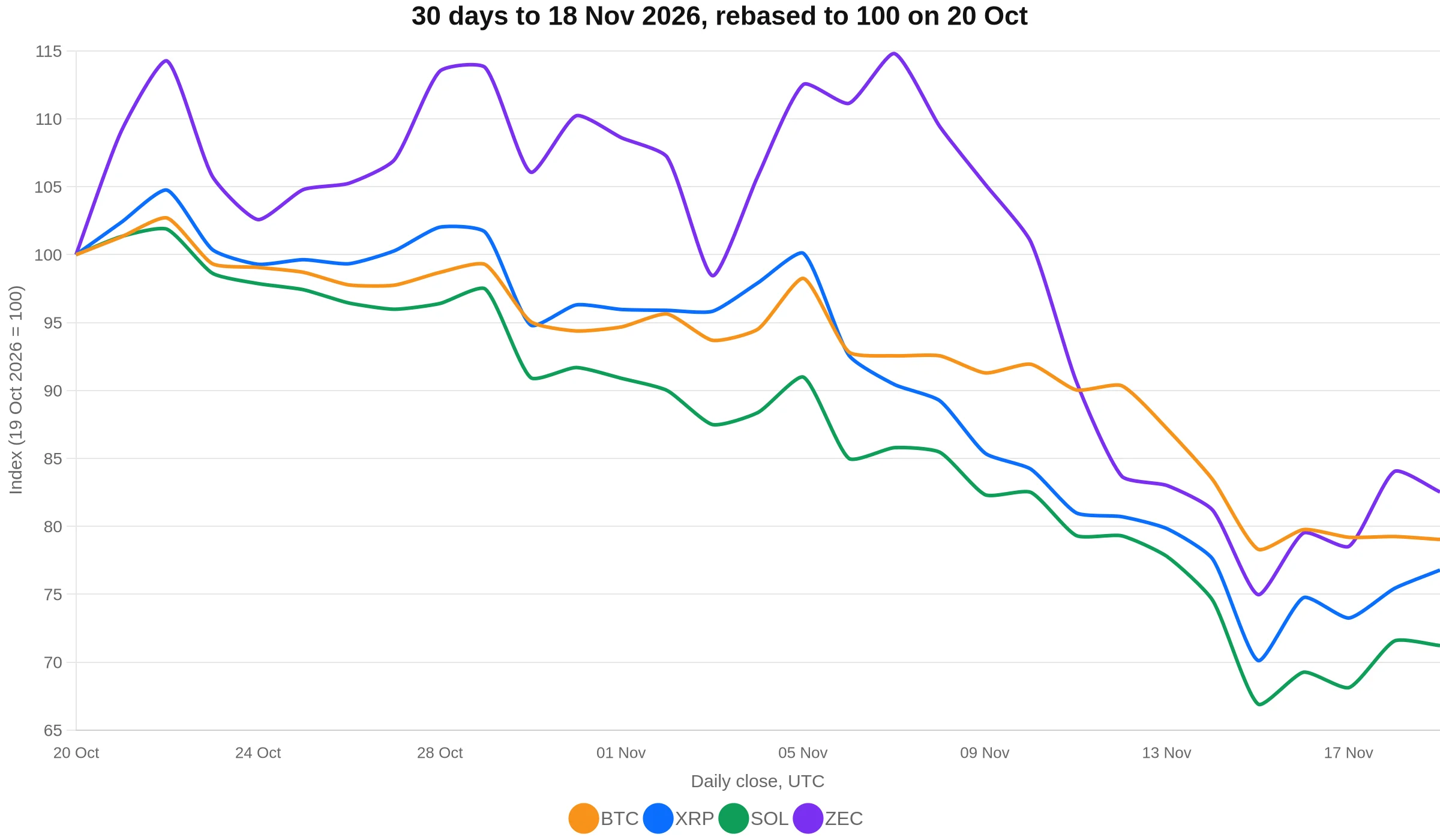
A green candle on a red week is a weak signal, and it is worth being precise about how weak. Bitcoin is 11.85% below its price of seven days ago and 20.97% below where it traded on 20 October, according to CoinGecko daily closes. The 30-day range runs from a low of $64,120 to a high of $84,082, which leaves the spot price 0.8% above the bottom of that range.
The dispersion inside that range is where the morning’s interest sits. Over 30 days, Zcash is down 17.47%, bitcoin 20.97%, XRP 23.22% and Solana 28.78%. Measured over one week, the order changes: XRP is down 4.93% against bitcoin’s 11.85%, a gap of 6.9 percentage points, while Solana gives back 8.99%. XRP’s month is worse than bitcoin’s; XRP’s week is far better. Both statements are true, and the difference between them is the whole question for anyone deciding what to add to a portfolio this week.
Sentiment has already priced the drawdown. Alternative.me’s crypto Fear and Greed Index reads 11 on 18 November, in its Extreme Fear band, after prints of 10, 10 and 12 on 15, 16 and 17 November. Across the 3,209 daily readings the index has published since 1 February 2018, 152, or 4.7%, have sat at 12 or below. That statistic says the current reading is rare. It does not say what happens next: the longest stretch at 9 or below in the index’s history ran for eight consecutive days in June 2022, and a rare reading is not a timing tool. BlockchainReporter’s review of the index’s earlier prints reached the same limit from the other direction.
What $1,000 Buys at 08:42 UTC
The table below is the whole comparison in one place, priced at the 08:42 UTC snapshot. Turnover is 24-hour dollar volume divided by market capitalisation, a ratio this article calculates from CoinGecko’s figures rather than a measure CoinGecko publishes.
| Asset | Price | 24h | 7d | Market cap | 24h volume | Volume / cap |
|---|---|---|---|---|---|---|
| Bitcoin (BTC) | $64,628 | +0.5% | -11.9% | $1.30T | $32.04B | 2.46% |
| Ether (ETH) | $1,808.81 | -0.6% | -11.6% | $221.1B | $11.89B | 5.38% |
| XRP | $1.001 | +4.6% | -4.9% | $63.56B | $1.79B | 2.82% |
| Solana (SOL) | $74.72 | +3.4% | -9.0% | $44.22B | $2.95B | 6.67% |
| Zcash (ZEC) | $947.88 | +3.4% | -2.8% | $16.16B | $0.73B | 4.51% |
A $1,000 ticket bought at those prices buys 0.01547 BTC, 0.5528 ETH, 999 XRP, 13.38 SOL or 1.055 ZEC. The unit counts matter less than the second column of arithmetic, which is the market capitalisation each asset would need to double from here: $2.60 trillion for bitcoin, $442.2 billion for ether, $127.1 billion for XRP, $88.4 billion for Solana and $32.3 billion for Zcash.
That single calculation separates the candidates more cleanly than any chart pattern. Bitcoin doubling would require adding $1.30 trillion of value to an asset that already sits 48.7% below its October 2025 record of $126,080. Zcash doubling would require $16.2 billion of new money. The smaller number is not the safer trade; it is the cheaper one to move, in both directions.
The Turnover Gap: Solana Trades 2.7 Times Bitcoin’s Rate
Volume divided by market cap is the closest thing to a measure of how much of an asset actually changes hands on a given day. On that measure Solana leads the group at 6.67%, followed by ether at 5.38%, Zcash at 4.51%, XRP at 2.82% and bitcoin last at 2.46%. Solana’s turnover is 2.7 times bitcoin’s, and it is doing that while sitting 28.78% lower over the month, the weakest 30-day performance of the four.
Two readings are possible, and the data does not choose between them. Heavy turnover on a falling asset can be capitulation finding a buyer, or it can be holders using every bounce to exit. The distinction needs order-flow or holder-cohort data that spot volume alone cannot supply. What the ratio does establish is that Solana’s price is being discovered actively, whereas bitcoin’s is being marked in a thinner market relative to its size. Anyone buying the smaller asset is buying liquidity risk alongside the discount.
The Fed Held at 3.75% to 4% and Two Voters Wanted a Hike
The 28 October statement is the macro fact that sits underneath every price in the table. The committee held, but not unanimously. “Voting against the monetary policy action were Lisa D. Cook and Beth M. Hammack, who preferred to raise the target range for the federal funds rate by 1/4 percentage point at this meeting,” the statement reads. Two dissents in the direction of tighter policy, on a committee that described activity as strong and inflation as elevated, is a different backdrop from the cutting cycle that carried risk assets higher in 2025.
What the record does not contain is a causal chain from that decision to bitcoin’s 11.9% weekly loss. The statement is the policy setting the market trades against, not a proven trigger for the move, and no single event in the public record accounts for a week in which every large token fell. Presenting the Fed’s hold as the cause would be a story the evidence does not support. The honest version is narrower: a committee that is not easing, two members who wanted to tighten, and a market that has spent the month repricing risk.
The next scheduled meeting is 8-9 December, according to the Fed’s own calendar. The minutes of the 27-28 October meeting had not been published on the Fed’s site as of 09:00 UTC on 18 November. Until they are, the balance of opinion inside the committee is known only from the vote.
XRP Is Back at $1 and Still 23% Lower on the Month
XRP’s move is the cleanest example of how a single session can mislead. The token traded as low as $0.9137 during the 30 days to 18 November and now sits 9.5% above that low, at $1.001. The round-number reclaim looks like a signal until the month is put beside it: 23.22% lower over 30 days is worse than bitcoin’s 20.97%, and 72.56% below the $3.65 record set in July 2025.
Recovering that record would take a 264.6% gain from $1.001. Bitcoin would need 95.1% to retake $126,080, ether 173.4% to reach $4,946.05 and Solana 292.5% to reach $293.31. Zcash’s CoinGecko all-time high of $3,191.93 is dated 28 October 2016, its launch day, so it is not a useful reference for the current cycle; this article uses the 30-day range instead.
What Would Turn a Green Morning Into a Signal
For the bounce to mean something more than a pause, two conditions need to hold, and both are measurable at the daily close rather than intraday.
The first is that bitcoin closes above the midpoint of its 30-day range, $74,101, which is the arithmetic midpoint between the $64,120 low and the $84,082 high. That would put the price back above where it traded in the first week of November and turn a 0.8% bounce off the low into a reclaim of the range’s centre.
The second is that turnover in the smaller names holds while their prices rise. Solana’s 6.67% ratio and Zcash’s 4.51% are the two figures to watch; a rally on falling turnover is a rally without buyers.
The invalidation is simpler. A daily close below the 30-day low in any of these assets, $64,120 for bitcoin, $0.9137 for XRP, $70.24 for Solana or $863.24 for Zcash, would mark the current green candles as a failed bounce inside a downtrend, and it would do so with the same data that produced today’s relative-strength reading.
Frequently Asked Questions
Is now a good time to buy crypto?
The data describes a market 11.9% lower on the week with the Fear and Greed Index at 11, and it does not identify a bottom. What it does show is that smaller assets are outperforming on the day while bitcoin trades 0.8% above its 30-day low. A buyer’s decision rests on whether they accept a further decline to that low, at $64,120, without a signal that the trend has changed.
Why is XRP back at $1?
XRP traded at $0.9137 at its lowest point in the 30 days to 18 November and has recovered 9.5% to $1.001, a 4.6% gain in 24 hours. No single verified announcement accounts for the move in the public record, and XRP remains 23.22% lower over 30 days, so the parity level is a recovery from a low rather than a new high.
Why is bitcoin down 11.9% this week?
Bitcoin is 11.85% below its price seven days earlier and 20.97% below its 20 October level, according to CoinGecko daily closes. The public record does not tie the decline to a single verified trigger. The Federal Reserve held rates at 3.75% to 4% on 28 October with two dissents favouring a hike, which is the policy backdrop rather than a proven cause.
What did the Federal Reserve decide on 28 October 2026?
The FOMC left the target range for the federal funds rate at 3-3/4 to 4 percent by a 10-2 vote. Lisa D. Cook and Beth M. Hammack dissented, preferring a 1/4 percentage point increase. The statement described economic activity as expanding at a strong pace and said inflation remains elevated. The next meeting is scheduled for 8-9 December.
What would invalidate the relative-strength case?
A daily close below the 30-day low for any of the four assets: $64,120 for bitcoin, $0.9137 for XRP, $70.24 for Solana or $863.24 for Zcash. A second condition is falling turnover while prices rise, which would show the bounce running without new buyers.
Data: CoinGecko, Alternative.me, Federal Reserve.
This article is for information only and is not investment advice. Prices are CoinGecko spot quotes at 08:42 UTC on 18 November 2026 and move continuously. Turnover is 24-hour volume divided by market capitalisation, and the Federal Reserve statement quoted is the 28 October 2026 decision.
About the author
Samuel is a professional cryptocurrency writer specializing in blockchain technology and market analysis. He delivers in-depth insights into emerging trends and developments, producing well-researched, engaging content that makes complex crypto topics accessible to both newcomers and experienced industry professionals. Through his analytical approach and clear writing style, Samuel provides valuable perspectives on the evolving digital asset landscape, establishing himself as a credible and trusted voice in the cryptocurrency industry.