


- 1. What the 20 November review changes on V3 Core
- 2. The 21 November follow-up: WETH, cbBTC and WBTC borrow caps
- 3. A supply cap of 1 on reserves that are already frozen
- 4. The full sheet: 34 cuts against 5 increases
- 5. Why the collateral menu is shrinking
- 6. What the cap sheet says that the vote summary did not
- 7. What happens next on the cap sheet
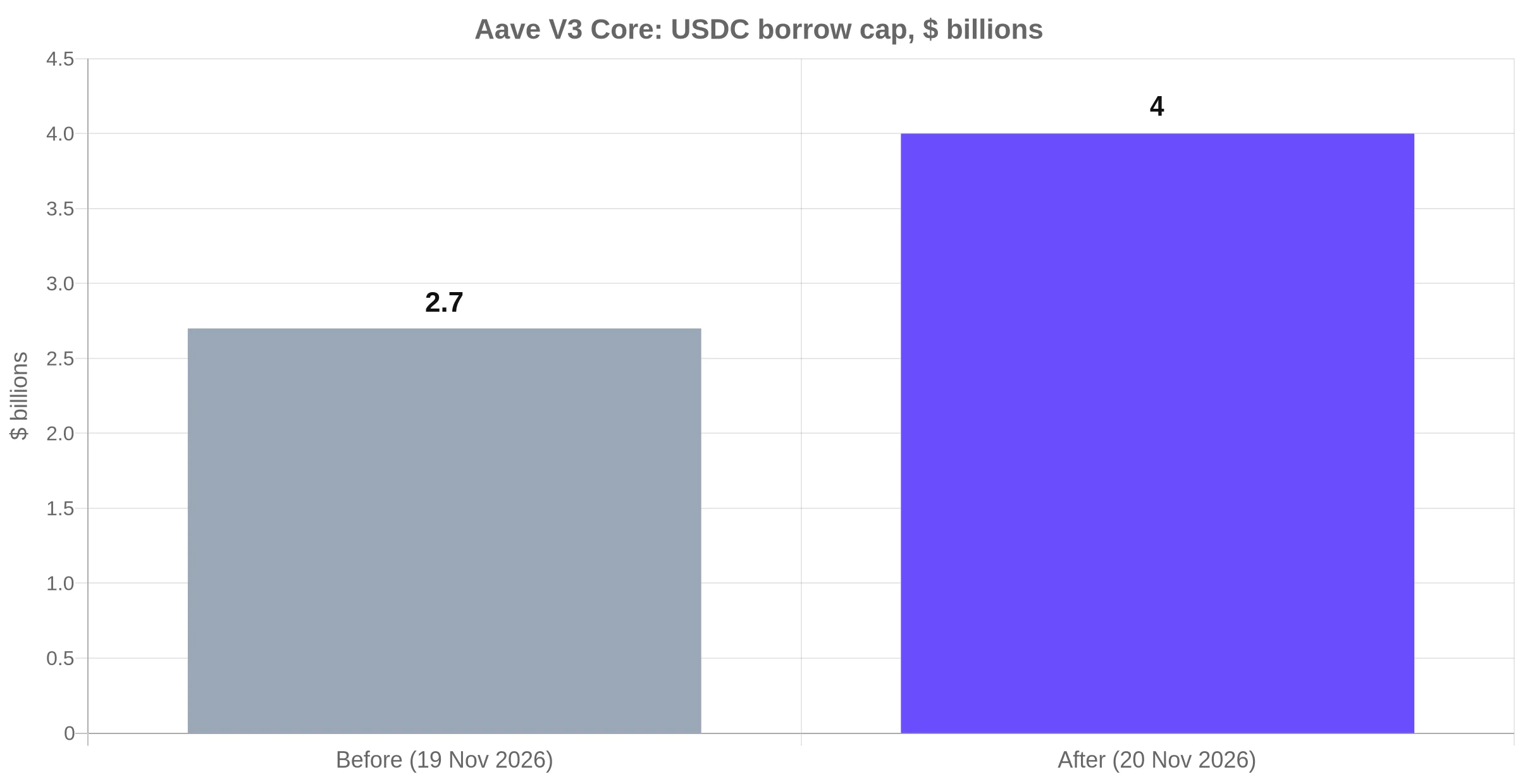
LlamaRisk, the risk service provider that acts as a steward on Aave’s parameter changes, published a 39-line cap sheet on 20 November. Five entries move up. Thirty-four move down. The biggest single move is on the borrowing side: USDC on Aave V3 Core goes from a $2.7 billion borrow cap to $4 billion, an increase of 48.15%, or $1.3 billion of new dollar capacity in the protocol’s most liquid market.
The same sheet cuts supply caps across nine Aave deployments, and ten of those reductions land on rsETH, wrsETH and tBTC at a cap of 1 token. Those reserves are already frozen, so the change does not remove any collateral that was usable that morning. It does write the freeze into the cap configuration, which is the part of Aave that borrowers and integrators actually read.
Both moves sit inside a bigger decision the DAO took earlier in the month. On 10 November LlamaRisk published an ARFC to reposition Aave V3 Core around “established and liquid collateral”, and the proposal put a number on the exposure in scope: “As of 9 November 2026 these assets held $1.33B of collateral backing $1.03B of debt.” The 20 November sheet is the parameter layer of that repositioning. It is not a market rumour, and it is not an emergency response to a price move.
The status of the change is worth stating exactly. The post does not give an execution timestamp. LlamaRisk writes that it “will move forward and implement these updates via the Risk Steward process” and points readers to its dashboard for applied changes. What follows describes the cap sheet as published on 20 November and the follow-up sheet of 21 November, not an on-chain confirmation of every parameter.
What the 20 November review changes on V3 Core
The increases are concentrated where utilization is already pinned to the ceiling. LlamaRisk’s own framing is mechanical rather than promotional: “USDC has reached 98.5% borrow cap utilization on the Aave V3 Core instance, with reserve utilization at 63.1%.” A borrower who wants USDC against ETH or BTC collateral at those levels cannot get it, because the cap, not the liquidity, is the binding constraint.
The concentration data behind that decision matters more than the cap number. LlamaRisk reports that “the top twenty USDC borrowers run health factors between 1.02 and 2.59 with a median of 1.42, and the largest borrower accounts for 14.4% of USDC debt.” A median health factor of 1.42 leaves roughly a 30% buffer before liquidation at current prices, and one address holds nearly a seventh of the debt. Raising the cap adds capacity to a book that is already thin at the bottom of the cohort, where health factors sit at 1.02.
The arithmetic on the cap checks out against the post’s own utilization figures. At 98.5% of the old $2.7 billion cap, outstanding USDC borrows come to about $2.6595 billion. Divided by the new $4 billion cap, that is 66.49% utilization, which is the 66.5% LlamaRisk states. The sheet is internally consistent, and the new headroom is real rather than a rounding exercise.
Alongside USDC, the 20 November sheet lifts the USDT borrow cap from $2.7 billion to $2.8 billion with the reserve at 93.8% borrow cap utilization, raises USDe supply from $750 million to $1 billion and sUSDe supply from $210 million to $400 million, and takes WBTC supply from 36,000 to 50,000 tokens with the reserve at 97.8% of its cap. It also trims the WETH interest-rate curve, cutting variableRateSlope1 from 2.20% to 2.10%. At the then-current 83.6% utilization that moves the variable borrow rate from 2.00% to 1.91%, which widens the gap between staking yield and borrowing cost for the eighteen of the top twenty WETH borrowers who post LST or LRT collateral.
The 21 November follow-up: WETH, cbBTC and WBTC borrow caps
The next day brought a second sheet, this time only on borrowing, and it tells the same story with BTC collateral. WETH goes from 1,850,000 to 2,150,000, cbBTC from 250 to 500, and WBTC from 900 to 1,500. All three were near their limits. LlamaRisk writes that “WETH has reached 99.5% borrow cap utilization on the Aave V3 Core instance, with reserve utilization at 86.3%”, and that cbBTC sits at 99.6% borrow cap utilization.
The cohort detail is the part a reader should keep. For WETH, LlamaRisk reports that eighteen of the top twenty borrowers post LST or LRT collateral (weETH, rsETH, wstETH and osETH) against WETH debt, with health factors between 1.01 and 4.94 and a median of 1.04. For cbBTC, the largest single borrower accounts for 67.1% of cbBTC debt. Those are the positions the new caps are designed to keep funded, and they are also the positions most exposed to a gap between a derivative token and the asset it tracks.
Two sheets in two days, one theme: where the collateral is ETH or BTC and the demand is for dollars, Aave is widening the door. Where the collateral depends on a layer outside the token, it is narrowing.
A supply cap of 1 on reserves that are already frozen
The reductions are where the repositioning becomes visible. Ten entries cut supply caps to a single token: rsETH on Core from 530,000, rsETH on Prime from 5,000, rsETH on Arbitrum from 90,000, and wrsETH on Plasma, Mantle, Avalanche, Base, Linea and MegaETH from between 5,000 and 70,000. tBTC on Core drops from 1,800 to 1.
None of those numbers describe a liquidity event. LlamaRisk is explicit about what a freeze does and does not do: “A frozen reserve accepts no new supply or borrowing, while existing positions can still be withdrawn, repaid and liquidated.” The caps being replaced were far above the supply sitting in the reserves, so cutting them changes nothing a user can execute. The stated purpose is bookkeeping: “Reducing the supply caps to 1 aligns the cap configuration with the frozen status.”
The size of the gap is the useful signal. rsETH on Core carries a supply cap that is about to become 1 against 273,599 rsETH supplied, a cap equal to 0.000365% of the outstanding position. tBTC on Core moves to a cap of 1 against 1,471 supplied, or 0.068%. A cap below outstanding supply is a label: the reserve is closed, and the parameter now says so in the same units integrators read.
| Frozen reserve | Deployment | Supplied | Cap before | Cap after |
|---|---|---|---|---|
| rsETH | V3 Core | 273,599 | 530,000 | 1 |
| rsETH | V3 Prime | 5.04 | 5,000 | 1 |
| rsETH | V3 Arbitrum | 16,466 | 90,000 | 1 |
| wrsETH | V3 Plasma | 0.02 | 5,000 | 1 |
| wrsETH | V3 Mantle | 15.31 | 70,000 | 1 |
| wrsETH | V3 Avalanche | 0.05 | 25,000 | 1 |
| wrsETH | V3 Base | 11,347 | 30,000 | 1 |
| wrsETH | V3 Linea | 564 | 5,000 | 1 |
| wrsETH | V3 MegaETH | 0.04 | 10,000 | 1 |
| tBTC | V3 Core | 1,471 | 1,800 | 1 |
Source: LlamaRisk, Risk Stewards: Supply and Borrow Cap and IRM Changes on Aave V3 / 2026.11.20, 20 November 2026.
The full sheet: 34 cuts against 5 increases
Across the two cap tables there are 39 parameter lines. Thirty-four reduce a cap, five raise one, and one interest-rate slope comes down. The supply-cap table below reproduces every line, including the three increases, so the shape of the rework is not hidden behind a highlights list.
| Instance | Asset | Supply cap before | Supply cap after |
|---|---|---|---|
| V3 Core | USDe | 750,000,000 | 1,000,000,000 |
| V3 Core | sUSDe | 210,000,000 | 400,000,000 |
| V3 Core | WBTC | 36,000 | 50,000 |
| V3 Core | BTC.b | 40 | 30 |
| V3 Core | eBTC | 100 | 85 |
| V3 Core | tBTC | 1,800 | 1 |
| V3 Core | rsETH | 530,000 | 1 |
| V3 Prime | rsETH | 5,000 | 1 |
| V3 Plasma | USDe | 525,000,000 | 400,000,000 |
| V3 Plasma | sUSDe | 175,000,000 | 140,000,000 |
| V3 Plasma | WXPL | 28,000,000 | 10,000,000 |
| V3 Plasma | wrsETH | 5,000 | 1 |
| V3 Mantle | syrupUSDT | 25,000,000 | 20,000,000 |
| V3 Mantle | sUSDe | 25,000,000 | 10,000,000 |
| V3 Mantle | WETH | 10,200 | 5,000 |
| V3 Mantle | WMNT | 2,400,000 | 1,000,000 |
| V3 Mantle | wrsETH | 70,000 | 1 |
| V3 Arbitrum | LINK | 690,000 | 350,000 |
| V3 Arbitrum | ARB | 30,800,000 | 25,000,000 |
| V3 Arbitrum | rsETH | 90,000 | 1 |
| V3 Avalanche | BTC.b | 1,500 | 1,300 |
| V3 Avalanche | wrsETH | 25,000 | 1 |
| V3 Base | LBTC | 50 | 25 |
| V3 Base | wrsETH | 30,000 | 1 |
| V3 Linea | WETH | 6,250 | 3,000 |
| V3 Linea | weETH | 2,880 | 1,000 |
| V3 Linea | ezETH | 510 | 400 |
| V3 Linea | wrsETH | 5,000 | 1 |
| V3 X Layer | xOKSOL | 75,000 | 25,000 |
| V3 X Layer | xSOL | 110,000 | 50,000 |
| V3 MegaETH | wrsETH | 10,000 | 1 |
Source: LlamaRisk risk-steward sheet of 20 November 2026, linked above. Borrow caps in the same review: USDC raised from $2.7 billion to $4 billion and USDT from $2.7 billion to $2.8 billion, with USDT0 on Plasma cut from $600 million to $475 million, USDT0 on Mantle from $90 million to $40 million, WETH on Mantle from 9,180 to 4,500, BTC.b on Avalanche from 79 to 50, WETH on Linea from 2,370 to 2,000, and xSOL on X Layer from 34,200 to 25,000. The 21 November sheet added the WETH, cbBTC and WBTC borrow-cap increases.
Why the collateral menu is shrinking
The 10 November ARFC sets out the reasoning in operational terms. It describes Core as an instance whose liquidity is pooled, so “each WETH and stablecoin supplier underwrites every collateral asset at the same pooled borrow rate”, and argues that a growing share of Core collateral now depends on layers outside the token: restaking services, leveraged wrapping strategies, derivatives in the backing, custom non-custodial bridges, and issuers whose security resourcing does not match their footprint.
The proposal is not the first pass. LlamaRisk notes that an earlier low-adoption deprecation round “wound down 71 reserves across eleven deployments, together with six whole markets, which held about $98M of supply in total”, and that an oracle deprecation replaced price feeds on long-tail assets with fixed values ahead of wind-down. The November round is aimed at the larger positions the earlier passes left alone.
The sequence has a structure worth naming, because it explains why a freeze and a cap cut arrive weeks apart. The ARFC freezes each reserve, sets its LTV to zero, and raises the reserve factor on any frozen reserve that is borrowable and carries more than $20,000 of debt to 99%. Migration then proceeds with each issuer and the largest borrowers. Stepwise liquidation-threshold reductions and, as a last step, interest-rate adjustments with targeted rebates are held back for positions that do not migrate.
Aave has run this playbook before under pressure rather than on a timetable. On 30 October the protocol froze V3 and V4 markets after a Binance exploiter deposited $60 million in USDT and borrowed 19,762 WETH. The current round is the quieter version: a scheduled narrowing, executed through parameter changes rather than an emergency alert.
What the cap sheet says that the vote summary did not
The frozen reserves are small in dollar terms and large in concentration terms. Adding the reported supplies across those deployments gives about 290,070 rsETH plus 11,926 wrsETH, or roughly 302,000 tokens if wrsETH is treated as one-to-one with rsETH. At the rsETH price of $1,863.32 on 23 November, that is about $562.7 million of collateral sitting in reserves where new supply is now capped at a single token.
Set that against the token’s own float. CoinGecko put rsETH’s market capitalization at $614.6 million at the same reading, which implies roughly 329,840 tokens in existence. On those figures, about 91.6% of all rsETH sits inside Aave markets that are now closed to new supply. The protocol is not exiting a small position; it is marking down where almost the entire supply of one restaked asset lives.
The asymmetry between the two halves of the sheet is the analytical point. A borrow cap only binds if borrowers hold collateral Aave will accept, and the increases on 20 and 21 November are all against ETH, BTC and stablecoin collateral. The cuts remove, or formally close, the collateral that depended on an external layer. Aave is not opening the risk box and closing it in the same week. It is narrowing what counts as collateral while expanding how many dollars can be borrowed against the collateral it keeps.
The market has not repriced AAVE for any of it. The token traded at $97.87 on 23 November with a market capitalization of about $1.51 billion, up 0.20% over 24 hours, according to CoinGecko. That is below the $109.47 recorded on 15 November, when the repositioning vote was the catalyst of the session.
What happens next on the cap sheet
Three things are worth tracking, and none of them require a price chart. The first is whether the USDC cap binds again. At $2.6595 billion of borrows against a $4 billion cap the reserve sits at 66.5%, but LlamaRisk notes that at current supply the cap corresponds to 94.8% reserve utilization, just above the 94.00% optimal usage ratio. Capacity that looks like headroom on the cap line is thin on the supply line.
The second is whether the frozen caps stay at 1. A cap of 1 is reversible in the same way a freeze is, and the ARFC leaves the door open: further controls apply only where exposure migration does not happen within the next months.
The third is the product layer. Aave Labs has been buying capability while the collateral menu narrows, most recently acquiring Avon to add fixed-rate lending. A protocol that is closing restaking exposure on its main instance and adding fixed-rate credit elsewhere is making a choice about which risks it wants to price. The 20 November sheet is that choice written in numbers a borrower can read before signing a transaction.
This article reports on published governance parameters. It is not investment advice and does not recommend any asset or position.
About the author
Tokoni Uti is a Lagos-based writer with several years of experience. Her work has appeared in the Huffington Post, the Los Angeles Free Press and the San Diego Free press among others. She is a graduate of Bowen University.