Blockchain News

Smart contracts, dApps, and the rise of cryptocurrencies like Bitcoin, Ethereum, Polkadot, Cardano, and more have spawned a new breed of use cases and services that run on public and private blockchains.

This new era of technology has taken the world by surprise, offering businesses, regulators, and ordinary users a chance to explore uncharted territories. A blockchain is a digital database distributed across a network of special computers called nodes. These nodes have a copy of the database and can seamlessly communicate. Anyone can join the network as a node operator and view the ledger’s contents. In essence, a blockchain is a digital ledger that records and stores data, which can be seen and accessed by everyone in the network in real-time. This distributed model assures the trustworthiness of the data because it’s impossible for one party to alter the data without the knowledge of other node operators, typically incentivized to keep the veracity of transactions.

How a Blockchain Works

Blockchain works by creating a network of computers that maintain a shared database. When a new piece of data, called a “block”, is created, it’s surrounded by a mathematical “hash” that makes it unique to that point in the network. Only the network can verify the data’s accuracy if a block of transactions is needed. This verification mechanism is the “hash”. It helps “chaining” the new block with the longer block of verified transactions, forming a blockchain. Once a block is “chained”, it is impossible to reverse posted transactions. This is why all blockchain transactions in a public database are considered immutable. Notably, any alterations in the block’s content would produce a different hash, alerting the network that data has been tampered with and is invalid. Its database will constantly grow as long as the network finds use and new blocks are added.

Blockchain Use Cases

Blockchain provides a secure and transparent platform for executing smart contracts. Smart contracts are pieces of code that automatically trigger when certain conditions are met. This minimizes the risk of fraud and reduces the cost of contracting. A blockchain can find application in regulatory compliance where it can find immense use in tracking assets, managing key processes, and auditing transactions. Furthermore, a blockchain can be used for storing data. As observed, publicly distributed blockchains provide a more efficient and secure way to store data. Stored data are openly and transparently accessible to all users. The blockchain can also find use in creating decentralized identity management systems. In this arrangement, the ledger can authenticate users, manage access to applications and store personal data. When integrated with an identity management system, the blockchain can be further used to keep data private. Data cannot be accessed or altered by third parties or organizations. At the same time, the blockchain can be used efficiently in supply chain management, where the technology can drastically improve logistics. Ordinarily, supply chains are complex and have many variables that make tracking challenging to use in traditional systems. This could make blockchain an appealing alternative.
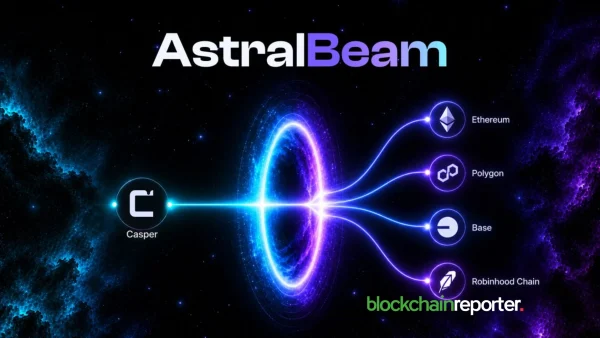

AstralBeam Launches on Casper to Enable Compliant Cross-Chain RWA Transfers

AstralBeam lands on Casper to connect tokenized RWAs across major blockchains while preserving compliance through the T-REX Ledger and ERC-3643 standard.

September 8, 2026
Ethereum Foundation Sets 2029 Quantum-Resistance Target for Layer 1

Ethereum’s protocol team mapped full and minimum post-quantum tracks through 2029, while warning the schedule requires overlapping research and fork work.

September 8, 2026
Crypto’s “Safest Asset” Just Lost 99% of Its Value

Stablecoins are becoming financial plumbing, but “stable” isn’t a safety guarantee. What matters is what backs the token and whether you can redeem it.

By Simeon
September 8, 2026
Kraken Pro Launches TWAP Orders Across Web, Desktop and Mobile

Kraken Pro now lets traders divide a large order into scheduled child orders, with price controls, one-minute-to-seven-day windows and API access.

September 8, 2026
XRP Healthcare Says Wallet Breach Affected 4,011 Users

The company traced about 445,000 DAI to one Ethereum wallet after unauthorized transactions affected roughly 4,011 XRPH Wallet users during its probe.

September 8, 2026
KuCoin Introduces KCUSD as Yield-Bearing Stablecoin Product

KuCoin launches KCUSD, a yield-bearing stablecoin product offering eligible users daily compounded returns, flexible redemption and future margin utility.

September 7, 2026
Why Governments and Institutions Are Putting Sovereign Debt Onchain

Explore why governments and institutions are moving sovereign debt onchain for faster settlement, lower costs, programmable assets and broader access.

September 7, 2026
Cheapest Crypto Prop Firms in 2026: Low-Fee Challenges Compared

Compare ten cheap crypto prop firm challenges by exact 2026 price, refund terms and execution venue, including CFT’s Bybit link, before you pay.

By Dan K
September 7, 2026
Tether-Backed Orionx Shuts Down After $7M Custody Gap

Chilean crypto exchange Orionx, backed by Tether, began a permanent shutdown after a forensic audit uncovered a $7 million gap in customer custody.

September 7, 2026
Ukrainian Police Take Down Crypto Scam Stealing $1M a Month

Ukrainian police and the SBU shut down a network of fake investment platforms whose crypto drainer stole up to $1 million a month from 20 countries.

September 7, 2026
FinCEN Ties $12.7 Billion to Crypto Scams Run From Asian Compounds

FinCEN said institutions reported activity tied to more than $12.7 billion in crypto investment scams run from compounds in Cambodia, Laos and Burma.

September 7, 2026
Poland Crypto Bill Blocked After Third Presidential Veto

Poland’s Sejm fell 25 votes short of overriding President Nawrocki’s third veto of a crypto bill, leaving the country without a MiCA supervisor.

September 7, 2026