

- 1. Key Takeaways
- 2. Table of Contents
- 3. The October 2026 Binance hack: what happened and where withdrawals stand
- 4. What security measures does Binance use?
- 5. Binance’s regulatory and legal record in the U.S.
- 6. Past security incidents and how Binance responded
- 7. Key risks you face as a Binance user
- 8. Practical steps to reduce your risk on Binance
- 9. How does Binance compare to Coinbase for U.S. users?
- 10. What Binance’s Proof of Reserves actually proves
- 11. Frequently Asked Questions
- 12. Final verdict: who should use Binance and what to do now
- 13. Useful primary sources
- 14. Sources
Last Updated: November 16, 2026
Binance is not fully back to normal after the October 29, 2026 hack, but Binance says customers will not lose money: on November 12 it said it had finished covering the roughly $6.3 billion stolen from its hot wallets with its own funds, and by November 14 it had reopened withdrawals on 87 networks.
For U.S. users the answer is different, because Binance.com does not serve U.S. residents. Americans use Binance.US, a separate company, and its CEO said Binance.US customer funds were not affected by the hack.
Binance.US is reasonably safe for active traders who turn on hardware-key two-factor authentication, whitelist withdrawal addresses and keep only trading-sized balances there. It is a poor place for long-term holdings, because it is custodial, crypto balances have no FDIC or SIPC protection, and the Binance group’s U.S. record includes a 2023 criminal plea.
Since 2025 the picture has changed: the SEC dropped its lawsuit against Binance and Binance.US in May 2025, and President Trump pardoned founder Changpeng Zhao in October 2025.
- In November 2023 Binance and its founder pleaded guilty to federal charges and agreed to a $4.3 billion resolution that included an independent compliance monitor.
- The October 29, 2026 hack hit Binance.com hot wallets. The FBI attributed it to North Korea’s TraderTraitor group on October 31. Binance says the losses will not be passed on to users, and on November 12 it said it had finished covering the affected assets.
- On November 12, the U.S. Justice Department said it had court authority to seize or restrain more than $1.2 billion of the stolen crypto, part of more than $2.7 billion frozen by U.S. authorities and private companies.
- Binance.com’s November 12, 2026 proof-of-reserves snapshot of 198 tokens shows BTC backed at 100.05% of user balances, up from 100.04% on October 31. It is Binance’s own snapshot, not an audit, and it does not cover Binance.US.
Key Takeaways
The table below is the short answer to “is Binance safe” for U.S. readers, updated for the hack and the withdrawal restart.
| Point | Details |
|---|---|
| Verdict for U.S. users | Binance.US is usable for active traders with strong security settings; not suited to passive long-term holding |
| Latest incident | About $6.3 billion taken from Binance.com hot wallets on October 29, 2026; FBI attribution to North Korea’s TraderTraitor on October 31 |
| Withdrawals now | Binance.com reopened withdrawals in phases from November 1 and had reopened 87 networks by November 14; it aims to reopen all remaining networks and assets by the end of the following week |
| Binance.US | Separate company; its CEO said customer funds were not affected by the hack |
| Who pays for the loss | Binance says it bears the loss from SAFU, its futures insurance fund and corporate treasury, and on November 12 said it had finished covering the affected assets; users are not charged |
| Frozen and seized funds | U.S. Justice Department court authority to seize or restrain more than $1.2 billion (November 12), part of more than $2.7 billion frozen by U.S. authorities and private companies |
| Proof of Reserves | November 12 snapshot of 198 tokens: BTC 100.05%, ETH 100.02%, USDT 104.34% (October 31: BTC 100.04%); Binance’s own figures, a transparency signal, not a full audit |
| Regulatory reality | 2023 guilty plea and $4.3 billion resolution; SEC lawsuit dismissed with prejudice on May 29, 2025; Zhao pardoned on October 23, 2025 |
| Top security step | Hardware security key or authenticator app, plus withdrawal address whitelisting |
| Self-custody rule | Move anything you are not trading to a hardware wallet you control |
Table of Contents
- The October 2026 Binance hack: what happened and where withdrawals stand
- What security measures does Binance use?
- Binance’s regulatory and legal record in the U.S.
- Past security incidents and how Binance responded
- Key risks you face as a Binance user
- Practical steps to reduce your risk on Binance
- How does Binance compare to Coinbase for U.S. users?
- What Binance’s Proof of Reserves actually proves
- Frequently Asked Questions
- Final verdict: who should use Binance and what to do now
- Useful primary sources
- Sources
The October 2026 Binance hack: what happened and where withdrawals stand
On October 29, 2026, attackers drained Binance.com hot wallets of about $6.3 billion in crypto, the largest theft from an exchange on record.
Binance’s initial findings report, published on November 3, puts the figure at about $6.34 billion and describes a campaign that ran for months: a wallet DevOps engineer installed a tampered developer tool in June, another engineer was approached in September through a fake job interview and given a malicious coding assignment, and on October 20 the attackers used a compromised machine to reach two more engineers.
On October 29 they ran a malicious script against the wallet signing service, with funds leaving from 20:05 UTC until containment at 00:10 UTC on October 30. Our report on the six-month attack chain behind the hack has the full timeline.
The FBI attributed the theft to TraderTraitor, a North Korean hacking unit, on October 31. Binance said on November 4 that about 98% of the affected tokens had been replenished with company money, and on November 12 that it had finished covering the affected assets, committing more than $6.34 billion of its own funds, and had published a new proof-of-reserves snapshot. Those are Binance’s own figures and have not been independently verified.
The same day, the U.S. Justice Department said it had court authority to seize or restrain more than $1.2 billion of the stolen crypto, part of more than $2.7 billion frozen by U.S. authorities and private companies, The Block reported. The department said efforts to trace, freeze, seize and forfeit the stolen assets are ongoing. Our report on the Justice Department’s $1.2 billion court order explains what a seizure or restraint order changes.
Can you withdraw from Binance now?
Yes, in phases. Binance suspended withdrawals on October 29 and kept deposits open. Phase one reopened 15 networks, including Bitcoin, Ethereum, BNB Smart Chain, Solana and the XRP Ledger, on November 1. In Recovery Update #6, Binance opened a second phase from 04:00 UTC on November 3 for 103 assets on nine networks, rolling out progressively after security checks, and repeated that “these losses will not be passed on to users.”
In Recovery Update #7 on November 4, Binance said about 98% of the hacked assets had been replenished. By November 14 it had reopened withdrawals on 87 networks, including Litecoin, Cardano and Avalanche, and said it aimed to reopen all remaining networks and assets by the end of the following week, Reuters reported, citing Binance’s post on X.
Binance has said affected tokens it no longer supports will go through its delisting process, so check the withdrawal page for each coin and network before moving funds. Our report on Binance reopening withdrawals after the hack tracks each step.
Is Binance.US affected by the Binance hack?
No customer losses have been reported at Binance.US. Binance.US CEO Stephen Gregory said that “customer funds at Binance.US are safe and were not affected by the incident at Binance,” according to TokenPost, and described Binance.US as operating with separate wallets, banking and operations. Binance.US is run by BAM Trading Services and does not share custody with Binance.com.
What does the hack mean for “is Binance safe”?
The hack shows both sides of the question. Hot wallet controls failed on a scale no exchange had seen before, which is a real security failure.
At the same time, Binance says it absorbed the loss, and it kept deposits open, published a zero-knowledge proof that ten major assets were still backed at least 1:1 on October 31, began paying out withdrawals within three days and had reopened 87 networks by November 14. The practical lesson is the same as before the hack: any balance on an exchange depends on that exchange’s security and solvency.
What security measures does Binance use?
Binance protects funds at two levels: platform controls that it runs, and account controls that you switch on. The October hack shows that platform controls can fail, so the account settings and your own custody choices matter more than any marketing claim.
Platform-level protections
Binance keeps most customer assets in cold storage, with a smaller share in hot wallets that process withdrawals. The October 29 theft came from hot wallets, which is why withdrawals stopped while cold storage stayed in place.
SAFU, the Secure Asset Fund for Users, is an emergency reserve that Binance created in 2018 and funds itself. It is not government insurance, and Binance decides when to use it.
In Recovery Update #3 on October 31, 2026, Binance said it had used part of SAFU, part of its futures insurance fund and corporate treasury to replace stolen assets, and it committed to replenishing SAFU to about $1 billion. Blockchain data showed the SAFU Bitcoin wallet holding about 7,500 BTC on November 3, after an outflow of about 7,499 BTC on October 31.
Binance.US runs its own custody, separate from Binance.com, and SAFU and Binance.com’s recovery funds belong to Binance.com.
Account-level controls
These controls protect you against the most common individual losses, which come from phishing, SIM swaps and stolen passwords rather than exchange hacks:
- Two-factor authentication with an authenticator app or a hardware security key (FIDO2, such as a YubiKey) instead of SMS, which is the weakest option.
- Withdrawal address whitelisting, so funds can only go to addresses you approved in advance.
- An anti-phishing code that appears in genuine emails from the exchange.
- Device and session management, so you can see and log out unknown devices.
- Login and withdrawal alerts by email or app notification.
Proof of Reserves: what it shows
Binance.com publishes monthly proof of reserves that combines a Merkle tree, which lets you check that your balance is included, with zk-SNARK zero-knowledge proofs, which show that total user balances are covered without revealing individual accounts.
After the hack it ran an extra snapshot at 00:00 UTC on October 31, 2026, and on November 2 it said the full proof was complete: BTC was backed at 100.04%, ETH and USDT at 100.00%, BNB at 101.30% and XRP at 100.99%, according to its proof of reserves page.
Binance took further snapshots at 00:00 UTC on November 4, with 44 tokens, and at 00:00 UTC on November 12, with 198 tokens, the day it said it had finished covering the affected assets. It said the full zero-knowledge proof for the November 12 snapshot would take 40 to 50 hours to generate.
On Binance’s proof of reserves page, read on November 14, the November 12 snapshot showed BTC backed at 100.05%, ETH at 100.02% and USDT at 104.34% of user balances. These are Binance’s own figures and have not been independently verified.
Pro Tip: if you hold assets on Binance.com, check your own inclusion with the verification tool on the proof of reserves page, and compare published wallet addresses on a blockchain explorer. Binance.com’s proof does not cover Binance.US balances.
Binance’s regulatory and legal record in the U.S.
Binance’s U.S. record is mixed: a criminal plea in 2023, then a sharp easing of enforcement in 2025. In June 2023 the SEC filed 13 charges against Binance entities and founder Changpeng Zhao (CZ), including claims of unregistered exchange operations and misuse of customer funds.
The case named Binance.US operator BAM Trading Services as well as Binance Holdings. Outside the U.S., regulators have pushed back too; in 2024, the Philippine SEC urged Filipino investors to exit Binance and asked Google and Apple to remove its app.
On November 21, 2023, Binance pleaded guilty to Bank Secrecy Act, unlicensed money transmitting and sanctions violations, and Zhao pleaded guilty to failing to maintain an effective anti-money laundering program. The total resolution with the Justice Department, Treasury and the CFTC was about $4.3 billion. Zhao stepped down as CEO and served a four-month prison sentence in 2024.
Three events since then changed the picture:
- On May 29, 2025, the SEC filed a joint stipulation to dismiss its case against Binance, BAM Trading and Zhao with prejudice, saying it made the decision “as a policy matter.”
- On October 23, 2025, President Trump granted Zhao a full pardon, as the White House confirmed to Reuters and other outlets.
- The 2023 plea agreement put Binance under an independent compliance monitor. Bloomberg reported in September 2025 that Binance was in talks to end the monitorship early, and in April 2026 Senator Richard Blumenthal asked the Justice Department about its status after New York Times reporting on transfers to Iran-linked entities. We found no public confirmation that the monitorship has ended.
Can you use Binance in the U.S. or New York?
Binance.com does not accept U.S. residents. Binance.US serves most states but, according to its support page dated June 3, 2026, is not available in 16 jurisdictions: Alaska, American Samoa, Connecticut, Georgia, Guam, Maine, the Northern Mariana Islands, New York, North Carolina, North Dakota, Ohio, Oregon, Texas, the U.S. Virgin Islands, Vermont and Washington. USD services are unavailable in Kansas and Wisconsin. New York residents therefore cannot use either Binance platform.
What this means for you in practice:
- Expect identity checks and occasional compliance reviews or holds, which can delay withdrawals.
- Binance.US lists fewer assets than Binance.com and has its own management, led by CEO Stephen Gregory since March 2026.
- State or federal action could still restrict access, though the 2025 SEC dismissal lowered that risk.
The wider shift in exchange rules is covered in our report on the compliance push across global exchanges.
Past security incidents and how Binance responded
Binance has been hacked before, and each time it covered user losses from its own funds. The October 2026 attack is by far the largest.
On May 7, 2019, hackers used phishing, viruses and other techniques to obtain user API keys and two-factor codes, and withdrew about 7,000 BTC, then worth about $40 million, from a Binance hot wallet in a single transaction. Binance paused withdrawals for about a week and covered the loss from SAFU, so no user lost funds.
In October 2022, an attacker exploited the BSC Token Hub bridge on BNB Chain, the blockchain Binance created, and minted 2 million BNB, worth about $570 million. Validators halted the chain, and Binance said only about $100 million to $110 million moved off BNB Chain before the funds were frozen. No exchange customer balances were affected.
On October 29, 2026, attackers took about $6.3 billion from Binance.com hot wallets, as described above. The FBI has attributed this theft to North Korea’s TraderTraitor, the same unit it linked to the $1.5 billion Bybit hack in February 2025. North Korean groups have stolen billions of dollars from exchanges, bridges and wallets in recent years, and the broader wallet security ecosystem has its own risks.
Pro Tip: SAFU and Binance’s recovery pledges cover platform breaches. They do not cover losses from phishing, SIM swaps or handing your login to a scammer, so your account settings are the only protection there.
Key risks you face as a Binance user
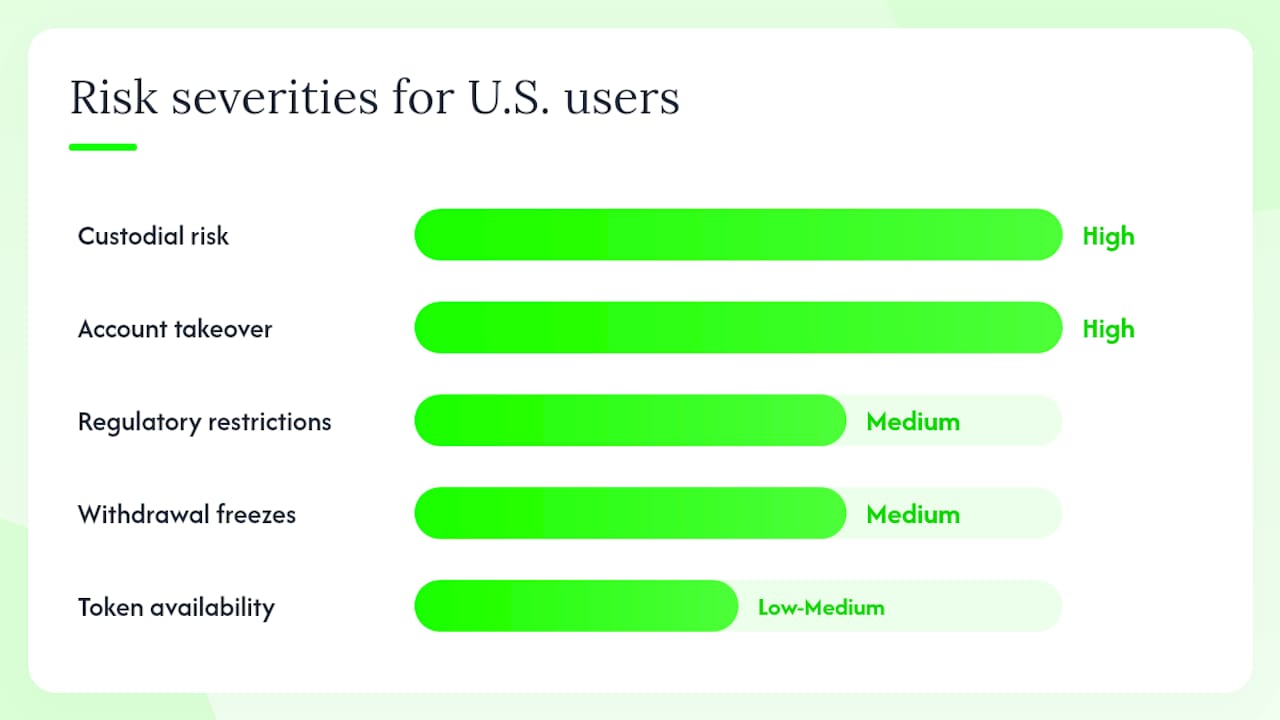
Blockchainreporter’s risk table rates each risk for a U.S. user of Binance.US as of November 2026.
| Risk | Severity for U.S. Users | Notes |
|---|---|---|
| Custodial risk | High | The exchange holds the keys; no FDIC or SIPC coverage for crypto |
| Account takeover (phishing, SIM swap) | High | The most common cause of individual losses |
| Exchange hack | Medium | Binance.com lost about $6.3 billion on October 29, 2026; Binance.US says its funds were not affected |
| Regulatory access restrictions | Medium | Binance.US is unavailable in 16 jurisdictions, including New York and Texas |
| Withdrawal freezes | Medium | Security incidents and compliance reviews can pause withdrawals, as on Binance.com from October 29 to November 1, 2026, with some networks still closed on November 14 |
| Token availability gaps | Low to Medium | Fewer assets than Binance.com |
| Platform insolvency | Low | No government backstop; SAFU covers Binance.com only and is discretionary |
Custody is the biggest structural risk. When you hold crypto on any exchange, you hold a claim on the exchange, not the coins themselves. Neither Binance.US nor Coinbase offers FDIC or SIPC protection for crypto. Cash in a USD wallet may be held at partner banks, so check the exchange’s own terms for whether pass-through FDIC coverage applies to you.
Account takeover is the most likely way an individual loses funds. Attackers send fake support messages, clone login pages and hijack phone numbers to intercept SMS codes. After the October hack, expect a wave of phishing emails and fake “recovery” or “compensation” sites that use the incident as bait.
Withdrawal freezes are not theoretical. Binance.com stopped all withdrawals from the evening of October 29 until the first networks reopened on November 1, some networks were still closed on November 14, and compliance reviews can hold individual accounts for longer.
Asset selection is narrower on Binance.US, so check that the tokens you want are listed before you deposit.
Practical steps to reduce your risk on Binance
You can cut most account risks in about 15 minutes. The checklist below works on Binance.US, Binance.com and most other exchanges:
- Switch two-factor authentication to a hardware security key (FIDO2) or an authenticator app, and remove SMS as a 2FA method.
- Set an anti-phishing code so you can recognize genuine emails.
- Turn on withdrawal address whitelisting and add only addresses you control.
- Review active sessions and devices, and remove anything you do not recognize.
- Treat any message about hack “compensation” or “refund claims” as phishing unless it appears in the official app or on the exchange’s own website.
- Move holdings you are not trading to a hardware wallet such as Ledger or Trezor, and keep the exchange balance to what you need for active trades.
Pro Tip: write your hardware wallet’s recovery phrase on paper or metal and store it offline. Never type it into a website, a form or a chat with “support.” Our guide to cold storage for crypto explains the setup.
How does Binance compare to Coinbase for U.S. users?
Coinbase has the cleaner U.S. regulatory record and wider state coverage, while Binance.US is usually cheaper for active spot trading.
| Dimension | Binance.US | Coinbase |
|---|---|---|
| Custody model | Custodial | Custodial |
| Crypto deposit insurance | None (no FDIC or SIPC for crypto) | None (no FDIC or SIPC for crypto) |
| Regulatory status (U.S.) | Group pleaded guilty in 2023 ($4.3 billion); SEC case dismissed with prejudice in May 2025 | SEC lawsuit filed 2023, dismissed in February 2025; no criminal case; publicly listed company |
| Availability | Not available in 16 jurisdictions, including New York and Texas | Available in all 50 states |
| Assets available to U.S. users | Narrower list | Broad list |
| Spot trading fees | 0% maker and 0.02% taker on most spot pairs (fee page, November 2, 2026) | Coinbase Advanced entry tier 0.60% maker and 1.20% taker |
| Recent security incidents | Binance.com hack of October 29, 2026 (Binance.US says it was not affected) | May 2025 data breach through bribed support contractors; Coinbase estimated $180 million to $400 million in costs |
| 2FA options | Authenticator app, security keys | Authenticator app, security keys |
| Proof of Reserves | Binance.com’s proof does not cover Binance.US; we found no current Binance.US report | No proof of reserves; audited financial statements filed with the SEC |
Coinbase’s SEC case ended on February 27, 2025, when the agency announced its dismissal. Coinbase’s May 2025 incident exposed customer data, not funds held in custody, but it fed social engineering scams against customers.
Binance.US fees are lower for active traders, but the lower fees come with fewer assets and fewer states. Coinbase’s simple buy screen costs more than Coinbase Advanced, so compare the order type you will actually use.
For long-term holders the comparison matters less than custody: whichever exchange you use to buy, a hardware wallet removes the exchange risk. Our best crypto exchanges ranking compares more platforms.
What Binance’s Proof of Reserves actually proves
Proof of reserves answers one narrow question: did the exchange hold at least as much of each asset as its users’ balances at the moment of the snapshot?
Binance.com’s method has two parts:
- A Merkle tree that lets each user confirm that their balance was included in the total.
- A zk-SNARK proof that the sum of all user balances is covered by the reserves, without revealing individual accounts.
The October 31, 2026 snapshot was the first after the hack, and Binance said on November 2 that its full zero-knowledge proof was complete for ten tokens: BTC, ETH, USDT, BNB, SOL, USDC, XRP, USD1, RLUSD and ZEC, each backed at least 1:1. Binance’s own pages say the report “is a snapshot and not a display of real-time assets.”
What proof of reserves does not show: liabilities outside customer balances, such as loans or legal claims; the quality of any collateral; how the company is governed; or what happened before or after the snapshot. It is a useful transparency signal, not a substitute for a full financial audit.
Binance.US is a separate company, so Binance.com’s proof of reserves says nothing about Binance.US balances. Our ranking of exchanges by proof of reserves transparency compares how major platforms publish theirs.
Frequently Asked Questions
Is Binance safe after the hack?
Binance says users will not lose money from the October 29, 2026 hack: on November 12 it said it had finished covering the roughly $6.3 billion loss with SAFU, its insurance fund and treasury, a claim not independently verified. Withdrawals reopened in phases from November 1 and covered 87 networks by November 14. The hack still shows that exchange balances carry real custody risk.
Is Binance safe for U.S. users?
U.S. residents cannot use Binance.com and must use Binance.US, a separate company. Its CEO said Binance.US customer funds were not affected by the October 2026 hack. Binance.US is reasonable for active trading with a hardware security key and whitelisted addresses, but it is custodial, has no FDIC or SIPC cover for crypto and is unavailable in 16 jurisdictions.
What’s happening to Binance right now?
Binance is recovering from the October 29, 2026 hack. By November 14 it had reopened withdrawals on 87 networks and said it aimed to restore the rest by the end of the following week. On November 12 it said it had finished covering the affected assets, and the U.S. Justice Department said it had court authority to seize or restrain more than $1.2 billion of the stolen crypto.
Who hacked Binance in October 2026?
The FBI attributed the October 29, 2026 theft to TraderTraitor, a North Korean state hacking unit, on October 31; North Korea denies involvement, Reuters reported. Binance says the attack began months earlier with a tampered developer tool and a fake job interview. On November 12, the U.S. Justice Department said it had court authority to seize or restrain more than $1.2 billion of the stolen crypto.
Has Binance been hacked before?
Yes. In May 2019 hackers stole about 7,000 BTC, then worth about $40 million, from a Binance hot wallet, and Binance covered it from SAFU. In October 2022 a bridge exploit on BNB Chain minted about $570 million of BNB, most of which was frozen. The October 2026 theft of about $6.3 billion is the largest exchange hack on record.
Is my money insured on Binance.US?
Crypto on Binance.US is not covered by FDIC or SIPC insurance, and the same is true at Coinbase and other U.S. exchanges. Cash held in a USD balance may be placed at partner banks, so check the exchange’s terms for any pass-through deposit coverage. Binance.com’s SAFU fund is a private reserve, not insurance, and it does not cover Binance.US accounts.
Can I use Binance in New York?
No. Binance.com does not serve U.S. residents, and Binance.US lists New York among the 16 jurisdictions where it does not operate, together with Texas, Ohio, Oregon, North Carolina and others. New York residents who want a regulated exchange need a platform licensed by the state, such as one holding a New York BitLicense or a state trust charter.
Is Binance legal in the U.S.?
Binance.US is licensed to operate in most U.S. states, while Binance.com is not permitted to serve U.S. residents. The group pleaded guilty to federal charges in 2023 and paid about $4.3 billion, but the SEC dismissed its civil case in May 2025 and founder Changpeng Zhao received a presidential pardon in October 2025.
Is Binance safer than Coinbase?
Coinbase has the cleaner U.S. record: no criminal case, a dismissed SEC lawsuit and audited public financial statements, although it suffered a customer data breach in May 2025. Binance.US usually charges lower spot fees but covers fewer states and assets. Neither insures crypto, so for long-term holdings a hardware wallet is safer than either exchange.
Does Binance’s proof of reserves prove my funds are safe?
It proves that, at the snapshot time, Binance.com held at least as much of each covered asset as users’ balances: its November 12, 2026 snapshot of 198 tokens showed BTC at 100.05%, by Binance’s own figures. It does not show other liabilities, events after the snapshot or Binance.US balances. Treat it as a transparency signal, not an audit or a guarantee.
Final verdict: who should use Binance and what to do now
Short verdict: Binance.US is a reasonable choice for active U.S. traders who want low spot fees and lock down their accounts, and a poor choice for storing savings. The October 2026 hack did not hit Binance.US customers, but it is a reminder that any exchange balance depends on the exchange’s security.
Binance.US suits you if you:
- Trade actively and value low spot fees.
- Accept custodial risk and keep only trading-sized balances on the exchange.
- Use a hardware security key or authenticator app, withdrawal whitelisting and an anti-phishing code.
- Live in a state where Binance.US operates.
Binance.US is a poor fit if you:
- Need the cleanest regulatory record or live in New York, Texas or another unsupported state.
- Want to hold large balances on an exchange for the long term.
- Need the full list of assets that Binance.com offers outside the U.S.
What to do now:
- Turn on hardware-key or authenticator 2FA and remove SMS.
- Set an anti-phishing code.
- Whitelist your withdrawal addresses.
- Remove unknown sessions and devices.
- Ignore any hack “compensation” message that does not appear in the official app.
- Move long-term holdings to a hardware wallet.
- If you also hold assets on Binance.com outside the U.S., check Binance’s announcements before sending funds while the phased withdrawal restart continues.
The 2023 plea and monitor were a compliance reset, and the 2025 SEC dismissal and pardon removed much of the U.S. legal overhang, but neither changes how custody works. For the full exchange review, see our Binance review.
This article is general information, not financial or legal advice. Check the current status and terms directly with Binance.US or Binance and consult a qualified professional before making decisions.
How we assess exchange safety at Blockchainreporter
Blockchainreporter rates exchange safety on four factors: the custody model, the record of security incidents and how the exchange responded, regulatory standing, and cryptographic transparency such as proof of reserves. For U.S. readers, regulatory standing and state availability carry extra weight, and every incident is dated and sourced.
Useful primary sources
These official documents are the best starting points for checking the claims on this page:
- DOJ press release: Binance and CEO plead guilty, $4.3B resolution, with the admissions and compliance conditions.
- SEC charges against Binance entities and founder (June 2023) and the SEC litigation release on the May 2025 dismissal.
- Binance Recovery Update #6 (November 3, 2026) and the Binance proof of reserves page.

News coverage named on this page comes from the FBI’s attribution as reported by CoinDesk and the Associated Press, The Block, TokenPost, Reuters, Bloomberg and The New York Times. For Binance.US availability and fees, check Binance.US directly. Updated by Blockchainreporter.
Sources
- Justice
- Sec
- SEC litigation release 26316
- Binance
- The Block: DOJ moves to seize $1.2 billion from Binance hack (November 12, 2026)
About the author
Jide Idowu is a skilled freelance writer with expertise in blockchain technology, cryptocurrency, and digital finance. Known for his ability to break down complex topics into clear, engaging content, Jide crafts articles, blog posts, and analyses that resonate with both beginners and seasoned professionals. His work spans a wide range of subjects, from emerging crypto trends to in-depth explorations of blockchain innovations. With a keen eye for detail and a passion for educating readers, Jide is a reliable voice in the rapidly evolving world of digital assets.