

- 1. Before the numbers: what a 13F can and cannot show
- 2. The spot book: a bigger IBIT and an almost-closed ether position
- 3. Where the money actually went: treasuries and miners
- 4. Puts grew almost three times faster than calls
- 5. What the September snapshot is worth in November
- 6. The next data point arrives Nov. 14
- 7. Frequently Asked Questions
JPMorgan Chase reported $2.63 billion of crypto-linked securities in the 13F-HR it filed with the SEC on Nov. 12, up from $1.68 billion at the end of June. The 56% increase is the number most summaries of the filing will carry. It is also the number that says the least, because a 13F marks positions at quarter end, and between June 30 and Sept. 30 the assets underneath most of those positions rose sharply.
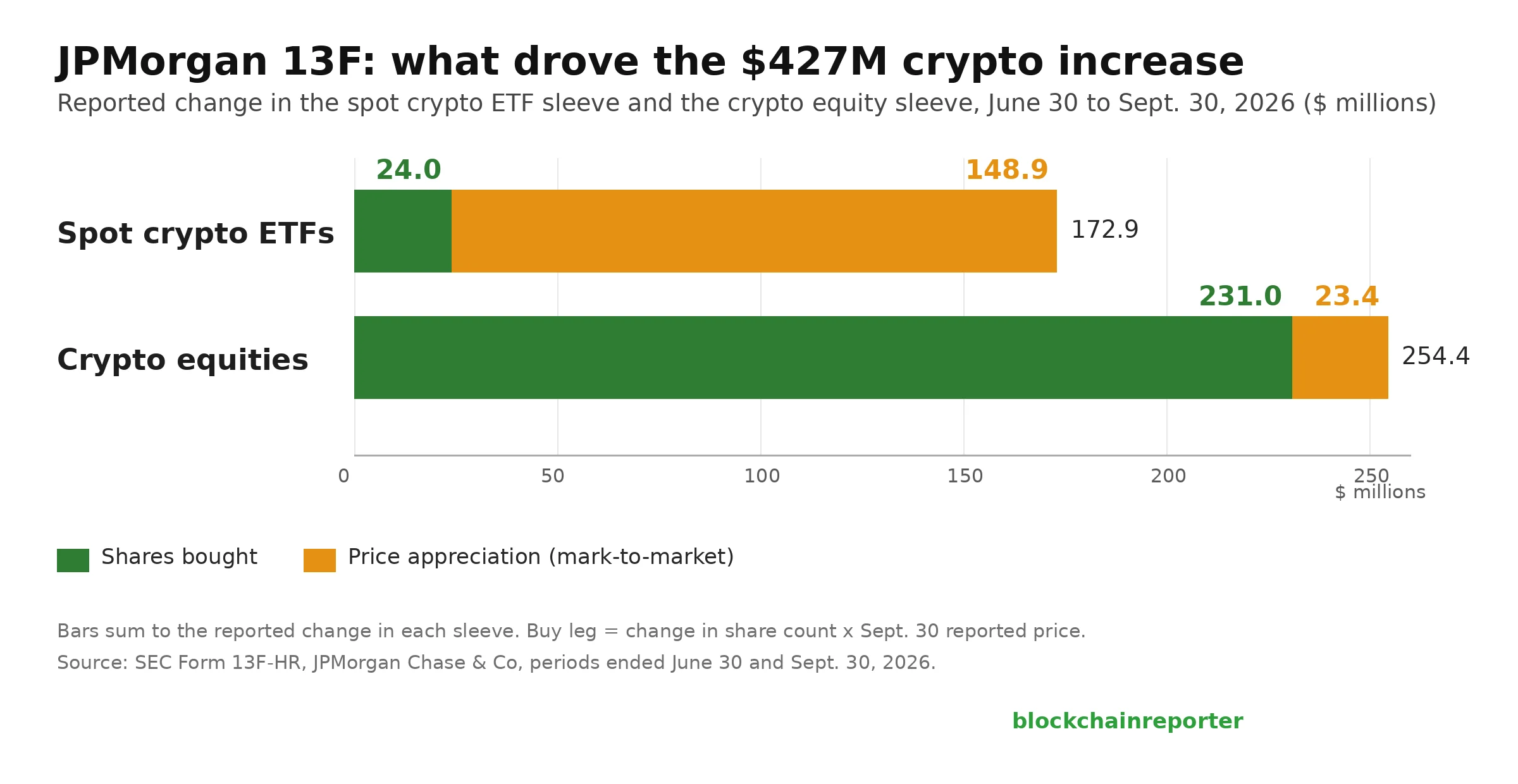
Separate the two effects and the picture changes. Across JPMorgan’s spot crypto ETFs and crypto equities, the $427.3 million net increase splits into $255.0 million of net buying and $172.4 million of price appreciation. That is 60% buying and 40% marks. In the ETF sleeve alone the ratio inverts: only $24.0 million of the $172.9 million increase came from adding shares.
Two positions account for most of the noise. JPMorgan added 1,001,295 iShares Bitcoin Trust shares, a 9.6% increase, and cut its iShares Ethereum Trust position from 1,169,431 shares to 399. The first looks like conviction and is mostly a rising bitcoin price. The second is the only clean, deliberate exit in the filing.
Before the numbers: what a 13F can and cannot show
The form is a quarterly snapshot of holdings in securities on the SEC’s Official List of Section 13(f) Securities, reported at fair market value as of the last day of the quarter. The SEC’s own guidance on the form sets the scope: filings must include “the issuer name of all Section 13(f) securities … the number of shares owned; and the fair market value of the securities listed, as of the end of the calendar quarter.” Values are in whole dollars. Until the 2022 amendments they were rounded to the nearest thousand, which is one reason older 13F-derived per-share figures do not reconcile.
Three limits matter for reading this one. JPMorgan’s filing aggregates 17 affiliated managers, among them J.P. Morgan Securities LLC, the broker-dealer, alongside the bank, the trust company and the asset management arms. Dealer inventory and fund positions sit in the same table as anything the bank runs for its own book, and the form does not tag which is which. Second, only securities on the Official List appear. Loans, swaps, privately negotiated positions, custody arrangements and most of JPMorgan’s actual crypto market-making franchise are invisible here. Third, the file is 45 days old on arrival: the SEC’s rule requires that “each filing is due within 45 days after the end of the calendar quarter,” which put this quarter’s deadline at Nov. 14.
So the crypto sleeve is a floor on JPMorgan’s exposure, not a measure of it, and the direction of travel inside the reported slice is only sometimes a house view.
The spot book: a bigger IBIT and an almost-closed ether position
The spot crypto ETF sleeve ended September at $549.6 million against $376.7 million in June. The iShares Bitcoin Trust line is $539.98 million of that, spread over 11,408,930 shares. At June 30 the same fund line was $355.7 million over 10,407,635 shares, the position reported as a $356 million stake in the June filing.
The arithmetic on the increase: 1,001,295 new shares valued at the Sept. 30 mark of $47.33 add $47.4 million. The 10,407,635 shares already held gained $13.15 each as the fund re-priced from $34.18, adding $136.9 million. Only 26% of the $184.3 million increase was buying.
Both fund marks can be tested against the assets they track. Bitcoin rose 39.0% from $60,152 on June 30 to $83,640 on Sept. 30, and the IBIT mark rose 38.5%. Ether rose 66.3% from $1,609.75 to $2,677.38, and the Ethereum Trust mark rose 65.7%. That is the check that the reported values are real market values in whole dollars rather than notional or thousands.
The ether side is the opposite case. JPMorgan held 1,169,431 iShares Ethereum Trust shares worth $14.31 million at June 30 and 399 shares worth $8,092 at Sept. 30. The position was closed to within rounding. Because ether climbed through the quarter, the exit was executed into strength rather than forced by a drawdown.
Smaller ETF lines were left alone: 4,095 Fidelity Wise Origin Bitcoin Fund shares, 66,264 Bitwise Bitcoin ETF shares, 600 Grayscale Bitcoin Trust shares and 155,785 Grayscale Bitcoin Mini Trust shares. The largest of the four is worth $5.8 million, and none changed by more than 7% of its own share count.
The rest of the sleeve carries a market value 58% as large as the spot and equity book combined: $967.0 million of reported option positions, up from $446.8 million in June. That total is one reason the spot headlines are a poor guide to positioning, and it is the part of the filing most often read backwards.
Where the money actually went: treasuries and miners
The equity book is where the buying happened. It rose to $1.11 billion from $858.2 million, and $231.0 million of the $254.4 million increase was new shares rather than marks. Eleven of the thirteen crypto equity lines ended September with more shares than they held in June.
BitMine Immersion was the single largest addition. JPMorgan bought 2,861,396 shares to reach 3,116,508, a 12.2-fold increase, worth $77.3 million at the Sept. 30 mark of $27.02 a share. That is fresh exposure to a company whose treasury strategy is to hold ether, and it is the only line in the filing where the purchase dwarfs any plausible price effect.
TeraWulf came second on share growth, 190,727 to 2,490,382, a 13.1-fold increase worth roughly $35.0 million at the quarter’s mark. BitDeer went from 370,041 to 963,124 shares, up 160%. Hut 8 added 256,260 shares, or 16.4%, and still recorded a $15.8 million decline in reported value, because the stock fell from $118.63 to $93.18 over the quarter.
The treasury-adjacent equities were accumulated in smaller size. Strategy rose to 848,932 shares from 624,387, a 36% increase and $34.7 million of buying. Coinbase rose to 1,581,814 shares from 1,395,552, 13.3% more and $35.4 million of buying. Block added 276,315 shares to reach 4,407,045, a position worth $326.3 million that makes it the largest single crypto equity line in the filing.
Not everything went up. CleanSpark was cut by 423,963 shares, or 25.5%, to 1,236,781. Galaxy Digital was trimmed 21%. Riot added 159,058 shares but its line lost $4.9 million of value as the stock fell from $28.10 to $21.68. Two small lines appeared or grew sharply: American Bitcoin with 13,219 shares, and SharpLink with 188,346 against 135,744.
| Position | Sept. 30 shares | June 30 shares | Change | Sept. 30 value |
|---|---|---|---|---|
| iShares Bitcoin Trust | 11,408,930 | 10,407,635 | +9.6% | $539.98M |
| iShares Ethereum Trust | 399 | 1,169,431 | -99.97% | $8,092 |
| Block | 4,407,045 | 4,130,730 | +6.7% | $326.34M |
| Coinbase | 1,581,814 | 1,395,552 | +13.3% | $300.58M |
| Hut 8 | 1,815,152 | 1,558,892 | +16.4% | $169.14M |
| Strategy | 848,932 | 624,387 | +36.0% | $131.30M |
| BitMine Immersion | 3,116,508 | 255,112 | +1,022% | $84.20M |
| TeraWulf | 2,490,382 | 190,727 | +1,206% | $37.93M |
| Riot Platforms | 1,454,591 | 1,295,533 | +12.3% | $31.54M |
| CleanSpark | 1,236,781 | 1,660,744 | -25.5% | $16.65M |
Puts grew almost three times faster than calls
The option lines are the loudest part of the filing and the easiest to misread. Reported put positions rose to $713.7 million from $256.2 million, a 179% increase. Calls rose 33%, to $253.3 million from $190.6 million. On underlying share counts, Coinbase puts went from 373,400 to 1,180,000 and the Coinbase call line was closed entirely, from 87,000 to zero. Strategy puts went from 715,700 to 1,148,500. BitMine puts went from 142,500 to 4,642,500, and Block puts from 50,000 to 425,400.
BitMine is the line that breaks the pattern. Its 4,642,500 put shares exceed the 3,116,508 common shares held, 149% coverage, which means the filing reports more downside protection on BitMine than BitMine stock.
What the form does not do is prove a bearish house view, and the SEC’s instructions explain why. Options that a manager writes are excluded: “You should not report put or call options that you write. This means that your short options positions like your short equity positions will not be reported on Form 13F or subtracted from a long position in the same issuer.” Every put in this table is therefore a long put, held rather than sold, and none of them offset the common stock lines above.
That still leaves strike prices, expiries and counterparties undisclosed, and it leaves the affiliated-manager problem intact. A 1.18 million share Coinbase put position inside a filing that includes a broker-dealer’s inventory can be a hedge, a client facilitation book, or a market-maker’s delta position. The share counts are facts. The intent behind them is not in the document.
One pattern is worth noting because it is measurable rather than interpretive. The put build was in place as of Sept. 30, before the October decline that took bitcoin under $70,000 and liquidated $1.62 billion of long futures positions in a single session. Whether the options anticipated that or simply coincided with it cannot be settled by a 13F.
What the September snapshot is worth in November
Mark the largest line to today’s price and the quarter’s work reverses. Bitcoin traded at $68,853 shortly after 18:30 UTC on Nov. 13, down 4.2% in 24 hours and 17.7% below the $83,640 close on Sept. 30. Applying that move to IBIT’s implied basket of roughly 0.000566 bitcoin per share puts the 11,408,930 shares near $444.5 million, about $95.5 million below the reported Sept. 30 value. The markdown is twice the $47.4 million the bank actually bought during the quarter.
Ether’s move is larger. At $1,938.59, ether is 27.6% below its Sept. 30 close of $2,677.38, which would have taken the Ethereum Trust line well below its June value had the position still been open. It was not, and that is the one decision in the filing that has aged in the bank’s favor.
The relative size is the part that survives both the marks and the caveats. At $2.63 billion, the crypto sleeve is 0.14% of a $1.84 trillion 13F book that grew 1.98% over the quarter. JPMorgan added roughly a quarter of a billion dollars of crypto equity exposure in three months and it still rounds to nothing against the Treasury and index positions in the same document, where a single iShares Core S&P 500 line fell by $5.7 billion.
The next data point arrives Nov. 14
JPMorgan filed a day before the deadline. Under the 45-day rule, the rest of the market’s Q3 13Fs are due Nov. 14, and the comparison that matters is not JPMorgan against itself but JPMorgan against the other banks and asset managers that hold the same instruments. Whether the BitMine build and the ether exit were idiosyncratic or part of a wider rotation is a question that a single filing cannot answer and a set of filings filed the same week can.
The Q4 filing, covering the quarter in which bitcoin fell below $70,000, is due in mid-February. That one will show whether the September put positions were closed at a profit, rolled, or exercised, and whether the 1 million IBIT shares added in the third quarter survived the fourth.
Frequently Asked Questions
What did JPMorgan’s Q3 2026 13F filing show?
The filing reported $2.63 billion across spot crypto ETFs, crypto equities and related options at Sept. 30, up from $1.68 billion at June 30. The largest lines were $539.98 million of iShares Bitcoin Trust, $326.34 million of Block, $300.58 million of Coinbase and $131.30 million of Strategy.
How much bitcoin ETF stock did JPMorgan actually buy?
It added 1,001,295 iShares Bitcoin Trust shares, taking the position to 11,408,930 from 10,407,635, a 9.6% increase worth $47.4 million at the Sept. 30 mark. The other $136.9 million of the reported increase came from the fund’s price rising from $34.18 to $47.33 a share.
Did JPMorgan exit its ether ETF position?
Almost entirely. The iShares Ethereum Trust line fell from 1,169,431 shares worth $14.31 million at June 30 to 399 shares worth $8,092 at Sept. 30, a 99.97% reduction. The fund’s share price rose over the same period, so the exit happened while ether was climbing, not during a selloff.
They do not establish that. Form 13F reports only long puts, because written options are excluded and cannot be netted against common stock, but it does not disclose strikes, expiries or which affiliated manager holds them. The filing aggregates 17 entities including the broker-dealer, so dealer inventory and fund positions appear alongside anything held for the bank’s own account.
Why is the 13F figure different from JPMorgan’s total crypto exposure?
Form 13F covers only securities on the SEC’s Official List of Section 13(f) Securities. Loans, swaps, custody balances, private placements and most market-making inventory are outside it, so the $2.63 billion is a reported floor rather than a measure of the bank’s full exposure.
When is JPMorgan’s next 13F due?
The Q4 2026 filing is due within 45 days of Dec. 31, 2026, which puts the deadline in mid-February 2027. The Q3 filings from other managers are due Nov. 14, 2026, two days after JPMorgan filed.
Data: SEC EDGAR Form 13F-HR, accession 0000019617-26-000404, prior-quarter information table, SEC Division of Investment Management 13F FAQ, CoinGecko. Bitcoin and ether quotes are snapshots taken shortly after 18:30 UTC on Nov. 13, 2026 and will change.
This article is not intended as financial advice. Educational purposes only. 13F holdings are reported as of Sept. 30, 2026 and do not represent current positions. Bitcoin and ether prices cited are snapshots taken shortly after 18:30 UTC on Nov. 13, 2026 and will change.
About the author
A freelance writer with a passion for crypto, delivering insightful and accurate content on blockchain and fintech. With a knack for translating complex concepts into accessible content, Eric produces well-researched articles, blog posts, and thought leadership pieces that cover the latest trends and developments in the digital finance space. His writing is aimed at educating and engaging both newcomers and industry experts, offering fresh insights into the world of cryptocurrencies, decentralized finance (DeFi), and blockchain innovations. Eric’s dedication to quality and accuracy makes him a trusted voice in the fintech and crypto communities