

The rally that carried Monero from $415.35 in mid-August to $640.02 on 5 November has been coming apart for two weeks, and 15 November showed how violent the unwinding has become. XMR traded below $500 through the Asian and European hours, printed $457.07, then reclaimed $503.86 by midday UTC before settling at $496.51 at 16:20 UTC, down 3.02% over 24 hours. The recovery leaves it 13.0% above its 200-day average of $439.34, a line that Bitcoin and Ether have already lost: Bitcoin at $64,639 sits 11.4% below its own 200-day average of $72,985, and Ether at $1,807.34 sits 15.7% below $2,145.06, according to CoinGecko’s Monero data, which puts XMR’s market capitalisation at $9.35 billion on $154.6 million of 24-hour volume.
The 12.4% range behind the $497 print
Hourly data dates the move to the hours after 21:00 UTC on 14 November. Monero closed that day at $529.53 after printing $535.31 at midday, broke below $500 within the hour and slid to $457.07, the low CoinGecko records for the last 24 hours. The 15 November session opened at $470.20, held $467.39 at 02:00 UTC, climbed to $489.06 by 06:00 and $503.86 by 12:00, and has since given back $7.35.
Two distances matter more than the headline loss. From the $457.07 low to the 24-hour high of $513.92, the range covers 12.44% of the low, a violent day inside a market that has been falling for two weeks. From that low to the current $496.51, the recovery is 8.63%, and the price still sits 3.39% under the high.
The $457.07 print is the weakest Monero has traded since 28 August 2026, when the daily close was $454.81. Volume does not confirm a capitulation read. The 14 November daily figure was $152.5 million against a 30-day average of $144.4 million, a multiple of 1.06, nothing like the expansion a forced-liquidation flush produces. What the tape supports is a deep intraday break that found buyers, not a completed distribution.
| Monero snapshot, 15 November 2026, 16:20 UTC | Value |
|---|---|
| Price | $496.51 |
| 24-hour change | -3.02% |
| 24-hour range | $457.07 – $513.92 |
| Seven-day change | -17.4% (from $601.10 on 8 November) |
| 90-day change | +19.5% (from $415.35 on 18 August) |
| From all-time high of $797.73 (14 January 2026) | -37.8% |
| Market capitalisation | $9.35 billion |
| 24-hour volume | $154.6 million |
| 20-day average close | $590.01 |
| 50-day average close | $572.61 |
| 200-day average close | $439.34 |
| 14-day RSI on daily closes | 30.7 |
Averages and the relative strength index are calculated by BlockchainReporter from 365 daily CoinGecko closes. The RSI uses Wilder’s 14-period smoothing.
The one average Monero is still above
A single moving average rarely separates one asset from a market, but the 200-day gap here is a 24.4 percentage point spread. Monero is 13.0% above its long average, Bitcoin is 11.4% below, and Ether is 15.7% below. On a day when Bitcoin traded as low as $62,081 and Ether as low as $1,713.65, XMR held a level it first reclaimed in the second half of August.
The shorter averages tell the opposite story. Monero is 15.9% below its 20-day average of $590.01 and 13.3% below its 50-day average of $572.61, both still falling. The gap between the 200-day at $439.34 and the 20-day at $590.01 is 34.3%, which is what a market that rallied for three months and then lost a fifth of its value looks like on a chart. The long average is the line that has not yet been broken; the short ones have.
Momentum puts Monero in a different position from the two largest coins. Its 14-day RSI sits at 30.7, barely above the 30 line that usually marks an oversold extreme, while Bitcoin’s reads 20.4 and Ether’s 20.5, both deep in territory that has historically preceded at least a short-term bounce. XMR fell harder than Bitcoin over the past seven sessions, 17.4% against 14.7%, yet its RSI is the higher of the three, because the September and October rally left it starting from a far more extended base. Falling toward a long average and falling through one are different events.
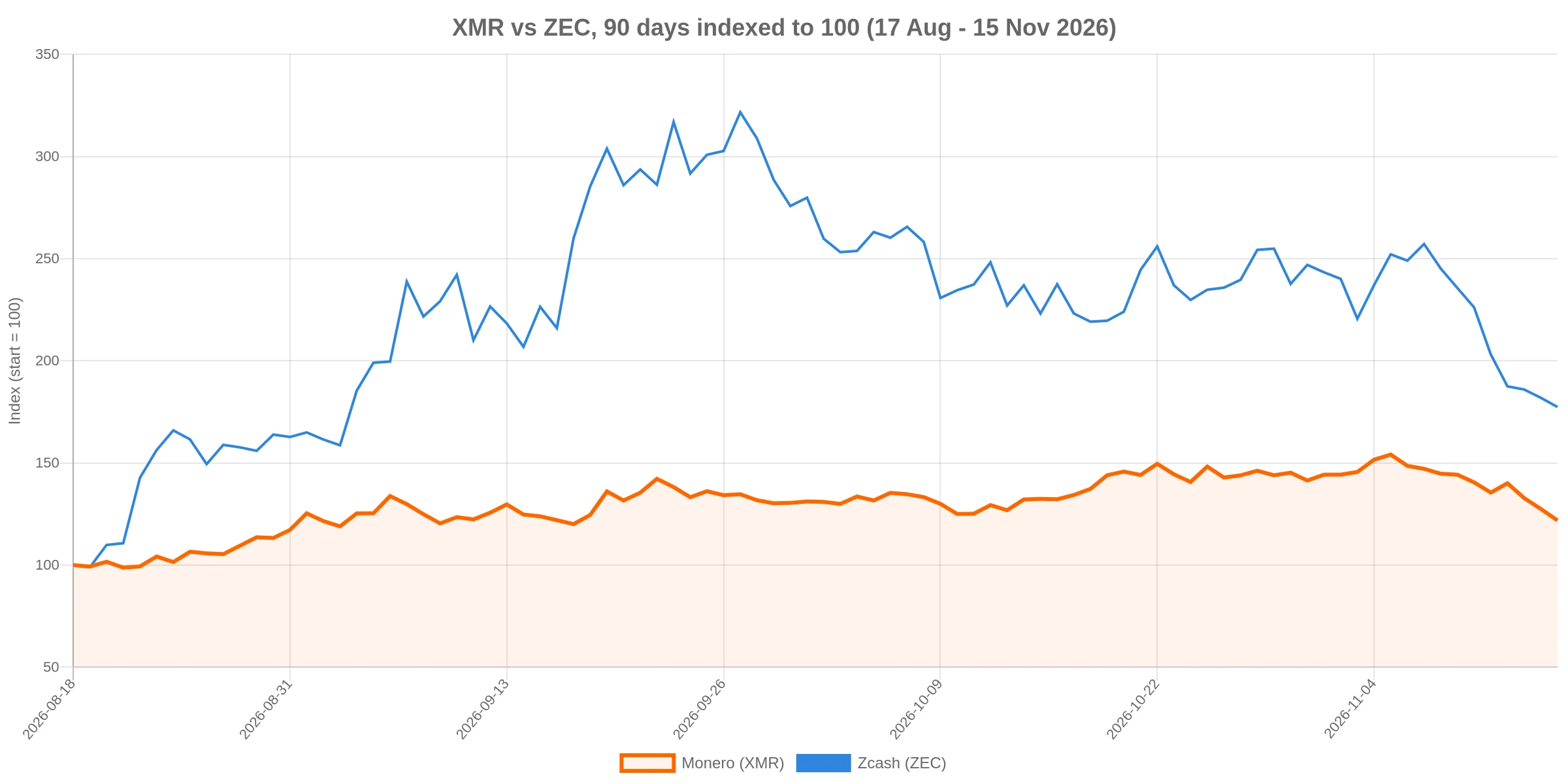
XMR has gained 64% on Zcash since September
The privacy sector has a second chart, and it belongs to Zcash. ZEC peaked at $1,653.12 on 27 September and trades at $895.02, a decline of 45.9%, a slide tracked session by session in BlockchainReporter’s own Zcash price coverage. Monero’s own move over the same window was $559.40 to $496.51. On 27 September Zcash cost 2.96 times what Monero did; today the multiple is 1.80 times, and the XMR/ZEC price ratio has risen from 0.3384 to 0.5547, a gain of 63.9% in relative terms.
Both assets are still higher than they were 90 days ago. From 18 August, XMR has added 19.5% and ZEC 74.2%, which is the residue of a rally that ran for two months before it broke. The relative trade is what changed. On 8 November Zcash closed at $1,259.82 and Monero at $601.10, a ratio of 0.4771, the point at which Monero’s market value was just under half of Zcash’s. By 12 November the ratio had reached 0.6037, its high for the month, before easing to 0.5773 on 13 November and 0.5665 on 14 November.
Today the two moved apart in the other direction. Zcash gained 3.21% while Monero lost 3.02%, so the ratio slipped to 0.5547 from 0.5665 at the 14 November close. Market capitalisation still favours Zcash by a wide margin: $15.25 billion against $9.35 billion, a multiple of 1.63, with Zcash turning over $1.14 billion in 24 hours against Monero’s $154.6 million, a ratio of 7.4 to one. Monero is the smaller, less traded asset that lost less of its 2026 gain.
Why the two coins are not interchangeable to buyers
The design difference is stated plainly by the project. The Monero Project’s own explanation puts it this way: “Unlike selectively transparent alternatives (e.g. Zcash), Monero is the only major cryptocurrency where every user is anonymous by default.”
The mechanism behind that default is described in the same document: “The sender, receiver, and amount of every single transaction are hidden through the use of three important technologies: Stealth Addresses, Ring Signatures, and RingCT.” A ring signature hides which of several possible signers authorised a transaction, RingCT conceals the amount, and stealth addresses generate a one-time address for each payment so the recipient’s public address never appears on the ledger.
The project draws a market consequence from that design: “Because every transaction is private, Monero cannot be traced. This makes it a true, fungible currency. Merchants and individuals accepting Monero do not need to worry about blacklisted or tainted coins.” Fungibility is the argument that a coin cannot be priced differently because of where it has been. Zcash, by contrast, offers both shielded and transparent addresses, and its supply, governance and upgrade path are separate matters that BlockchainReporter has covered on their own terms.
For a reader deciding between the two, the practical difference in this market is liquidity and volatility rather than privacy doctrine. Zcash’s 90-day index rose from 100 to a peak of 321.7 on 27 September and now sits at 174.2, while Monero’s peaked at 154.1 on 5 November and sits at 119.5. The smaller asset has been the steadier one since September, and the larger one has carried both the upside and the reversal.
Where the next levels sit
The levels below come from daily closes and 24-hour extremes on CoinGecko data, not from a drawn trendline. Each has a stated basis and an invalidation.
$457.07 is the first line. It is the 15 November low and the weakest print since 28 August. A daily close below it would open $410.22, the 90-day low set on 21 August, and would also mark the first close under the 200-day average since that month, a level currently at $439.34.
On the other side, $513.92 is the 24-hour high and $529.53 the 14 November close, with the 50-day average of $572.61 above both. The 90-day high of $640.02, set on 5 November, is 28.9% above the current price; at that level Monero’s market capitalisation would be $12.05 billion rather than $9.35 billion.
Momentum is neither washed out nor recovered. A 14-day RSI of 30.7 sits almost exactly on the line that usually marks an oversold extreme, and it has not yet produced the sub-20 readings Bitcoin and Ether are printing. That combination, a falling short average and an RSI at the threshold, argues for a market grinding lower rather than one that has already capitulated.
What would change the read
Three observable things matter from here. The first is whether 15 November closes above $457.07. Holding the level would keep today’s print a wick rather than a settlement, the same distinction that mattered for the 14 November candle at $529.53.
The second is whether Monero keeps its distance from Bitcoin’s own 200-day average. Bitcoin at $64,639 is 11.4% under $72,985, and a broad market that cannot reclaim that line tends to drag the relative-strength names with it eventually. Monero’s 24.4 percentage point advantage is the buffer being tested.
The third is the XMR/ZEC ratio, which has become the cleanest read on where privacy-coin money is sitting. It peaked at 0.6037 on 12 November, eased to 0.5665 on 14 November and sits at 0.5547 now. A break back under 0.4771, the 8 November level, would say the September-to-November rotation has reversed rather than paused.
What the data does not establish is why today’s range happened. A 12.44% intraday swing with volume at only 1.06 times its 30-day average is consistent with thin-book volatility in a falling market, and no Monero-specific announcement, upgrade or governance event appears in the record for 14 or 15 November. Attributing the move to a single cause would require evidence this price and volume record does not contain.
Frequently Asked Questions
Where is Monero trading right now?
Monero traded at $496.51 at 16:20 UTC on 15 November 2026, down 3.02% in 24 hours, according to CoinGecko’s spot snapshot. It is 8.63% above the session low of $457.07 and 3.39% below the session high of $513.92.
Why did Monero fall below $500 on 15 November?
Monero closed 14 November at $529.53, broke below $500 that evening and fell to $457.07 before recovering to $503.86 by midday on 15 November. The move came in a market where Bitcoin traded 11.4% below its 200-day average, and volume was only 1.06 times the 30-day average. No Monero-specific announcement explains the range, and the data does not establish a single cause.
Is Monero still above its 200-day average?
Yes. Monero’s 200-day average close is $439.34 and the price is 13.0% above it. Bitcoin is 11.4% below its own 200-day average of $72,985 and Ether is 15.7% below $2,145.06, so Monero holds a 24.4 percentage point advantage over Bitcoin on that measure.
How does Monero compare with Zcash right now?
Zcash trades at $895.02, down 45.9% from its 27 September peak of $1,653.12, and carries a $15.25 billion market capitalisation against Monero’s $9.35 billion. Zcash’s 24-hour volume of $1.14 billion is 7.4 times Monero’s $154.6 million. The XMR/ZEC price ratio has risen from 0.3384 on 27 September to 0.5547.
What is the next support level for XMR?
The first support is $457.07, the 15 November low and the weakest print since 28 August 2026. A daily close below it brings $410.22, the 90-day low set on 21 August, into play, with the 200-day average at $439.34 sitting in between as the test that would invalidate the relative-strength case.
Prices, averages and the relative strength index are point-in-time snapshots taken at 16:20 UTC on 15 November 2026 and will change. Averages, percentage changes, the XMR/ZEC ratio and the RSI are calculated by BlockchainReporter from the CoinGecko daily closes cited above. This article is not investment advice.
Data: CoinGecko, The Monero Project.
About the author
Samuel is a professional cryptocurrency writer specializing in blockchain technology and market analysis. He delivers in-depth insights into emerging trends and developments, producing well-researched, engaging content that makes complex crypto topics accessible to both newcomers and experienced industry professionals. Through his analytical approach and clear writing style, Samuel provides valuable perspectives on the evolving digital asset landscape, establishing himself as a credible and trusted voice in the cryptocurrency industry.