Upbit attached a trading caution designation to Kava (KAVA) at 14:00 KST on Monday, 16 November 2026, which is 05:00 UTC. The label covers both won and bitcoin pairs, and it comes without a reopening date for deposits: the exchange’s notice says deposit service will resume “according to the procedure after the trading caution designation”, and names no day.
KAVA/KRW and KAVA/BTC are the two affected markets. The designation runs until the third week of December, 14 to 18 December, and Upbit has reserved the right to end trading support entirely at the end of that review. The token traded at $0.03425 at 06:44 UTC on 16 November, down 5.6% in 24 hours and 49.8% over seven days, according to CoinGecko.
What the Upbit Notice Actually Ordered
The notice is short and its terms are specific. Upbit cited Article 17, item 1, sub-item “mok” of the enforcement decree of Korea’s Act on the Protection of Virtual Asset Users. The clause it quotes describes the trigger condition: a hacking or other security incident “whose cause has not been identified or remedied” occurring in a wallet controlled by the asset, its issuer or its operator, or in the distributed ledger where the asset is issued, transmitted or stored.
Upbit then states its conclusion in one sentence. The exchange “confirmed that there is a possibility of causing damage to users” and designated KAVA for investor protection. That phrasing matters, because it stops short of asserting that KAVA holders have already lost funds. The designation is precautionary in its stated logic and punitive in its mechanics: from the moment the notice was published, deposits into KAVA no longer count. The notice says incoming transfers cannot be credited and that all such deposits fall under a return process.
Withdrawals are the other half. They were already off. Upbit suspended KAVA deposits and withdrawals at 19:36 KST on 14 November, which is 10:36 UTC, and the 16 November notice confirms that when service resumes it will resume for withdrawals only. Deposit resumption is tied to whatever follows the designation review, not to a fixed date.
Forty-Two Hours From Network Warning to Designation
Upbit did not move straight to the harshest label. Its first step was a caution warning, published at 20:00 KST on 14 November, twenty-four minutes after the transfer suspension. That notice is a one-paragraph alert and it identifies the problem at the network level rather than the token level: “On 14 November 2026, circumstances were identified that suggest a security problem occurred on the KAVA chain”, it reads, adding that price volatility could widen.
| Time (UTC) | Action | Source |
|---|---|---|
| 14 Nov, 10:36 | KAVA deposits and withdrawals suspended | Upbit notice, 16 Nov |
| 14 Nov, 11:00 | Caution warning issued to holders | Upbit notice 6777 |
| 16 Nov, 05:00 | Trading caution designation effective; deposits frozen | Upbit notice 6780 |
| 14 to 18 Dec | End of the announced review window | Upbit notice 6780 |
The interval from suspension to designation is 42 hours and 24 minutes. The interval from the first warning to the designation is two days and eighteen hours. Whatever remediation the Kava team has attempted in that window has not been enough to keep the token in Upbit’s ordinary listing tier, and Upbit’s own wording says the underlying cause is not resolved.
KAVA Is on the Third of Four Rungs
Upbit publishes the ladder it is climbing. Its digital asset trading support termination policy describes a joint-response sequence used by members of DAXA, the council of Korean exchanges: a crisis occurs, a caution warning is issued, the asset is designated a trading caution item, and trading support is terminated if the problem persists.
KAVA entered at rung two on 14 November and reached rung three on 16 November. Rung four is not automatic, and the policy is explicit that the committee weighs severity, the likelihood of resolution and the need to protect users across five review areas: issuer reliability, user protection safeguards, technology and security, legal compliance, and content-based assets. But the notice also states the downside in plain terms: “The review period may be extended, and if the reasons for the designation are not fully resolved, termination of trading support may be decided.”
Termination has its own arithmetic, and it is published. The policy grants a 30-day orderly trading period from the date of the termination notice, so holders keep a market in which to exit. It then supports withdrawals for 30 days from the termination date, absent special circumstances. After that window closes, the policy warns, storage fees may be charged on top of withdrawal fees. Read end to end, a termination decided at the far edge of the 14 to 18 December window would leave roughly 60 days of exit runway, landing in the second half of February 2027.
What a Frozen Deposit Side Does to Price Discovery
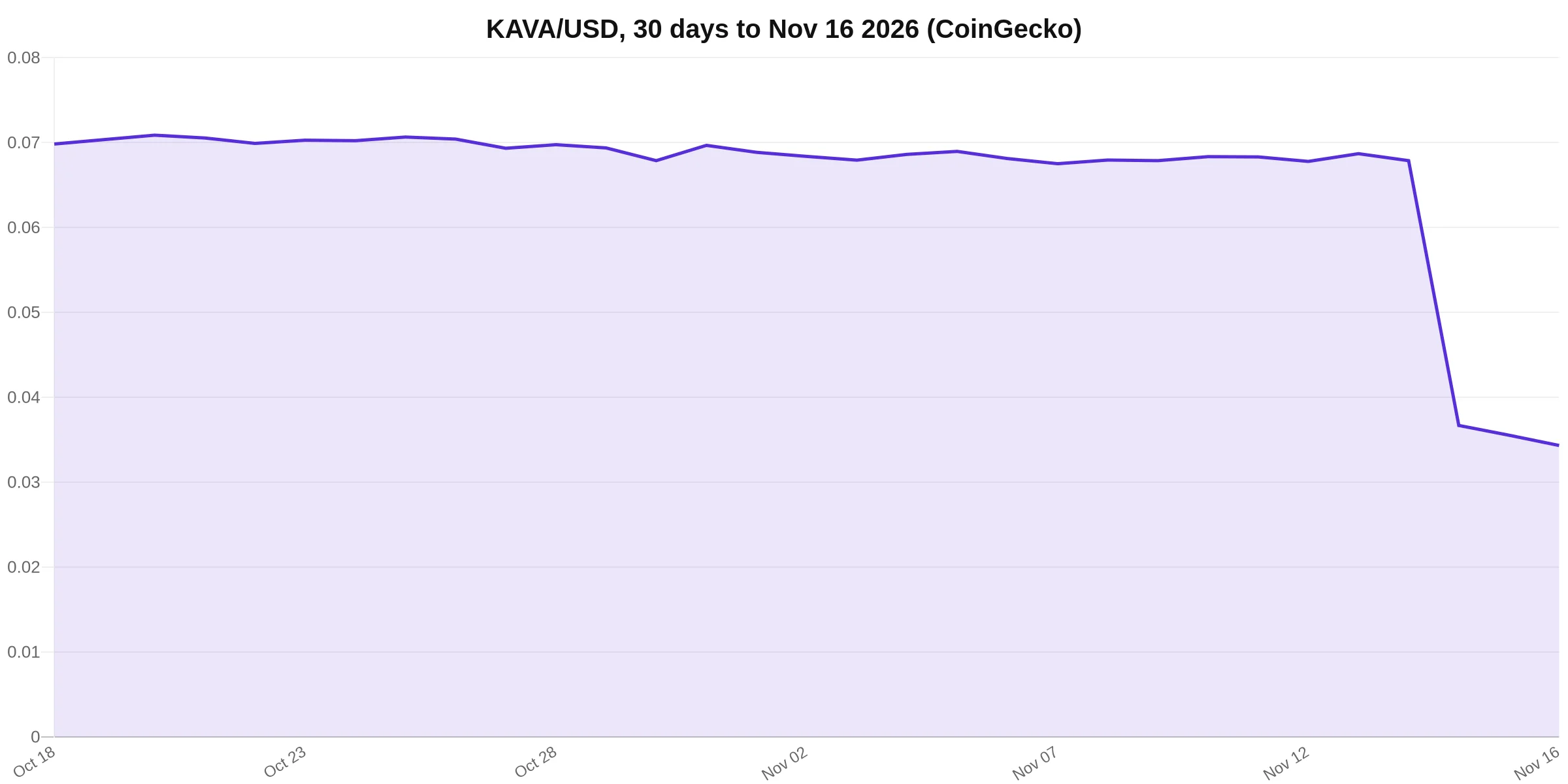
The chart above is the whole story in one line. KAVA held between $0.0678 and $0.0705 for the month to 13 November, then fell by roughly half in a single step. The 24-hour range on 16 November ran from $0.03291 to $0.04052, a 23.1% spread inside one session, with the price closing 15.5% below the session high. Market capitalisation is $37.09 million against $21.39 million of 24-hour volume, which means turnover equal to 57.7% of the entire float changed hands in a day.
Distance from the old high is the number that frames everything else. KAVA last printed $9.12. At $0.03425 it would need to multiply by 266 times, a 26,500% gain, to revisit that level. The seven-day comparison is equally blunt: KAVA lost 49.8% while bitcoin lost 13.9%, an underperformance of 35.9 percentage points in a week when the whole market was selling off.
A frozen deposit side changes who is trading. Korean won liquidity no longer pulls in offshore supply, because coins sent to Upbit cannot be credited, so the Korean book trades against itself. That typically widens the gap between the won price and the global price, and it removes one of the few channels that normally arbitrages the two. Holders who bought on Upbit and want out are competing for bids inside a market that has lost its inbound flow, while holders offshore have no reason to route coins into a venue that will not accept them.
What Holders Can and Cannot Do
Trading in the two KAVA pairs continues for now, which is the practical difference between a caution designation and a suspension. Holders can sell into the won or bitcoin book while the review runs. What they cannot do is move coins in: the deposit side is shut, and any transfer that arrives is earmarked for return rather than credit.
Withdrawals depend on Upbit’s next announcement. The 16 November notice promises that only the withdrawal function will resume when service returns, and it does not say when that will be. It also does not say what evidence Upbit needs before it lifts the designation, whether the underlying chain issue has been remediated, or whether the exchange has set a threshold the Kava team must meet. Those are open questions, and the notice leaves them open.
One asymmetry is worth flagging for anyone tracking the story. Upbit’s notice describes an unresolved security incident. Kava’s own news page carried no incident statement or post-mortem as of 06:47 UTC on 16 November, and its most recent published post there is dated 3 November. The project may have communicated through other channels; what this article verified is the absence of a public explanation on its website, which is precisely the gap an “unresolved cause” finding points to.
The Precedent on the Same Exchange
Upbit ran this exact procedure three weeks ago. On 26 October it designated Initia’s INIT a trading caution asset under the same statutory clause, hours after Bithumb did the same, following a $2.7 million exploit whose cause had not been established. The INIT file set a review deadline in the fourth week of November, which is four weeks after designation.
KAVA’s window is the same length. Designated on 16 November with a review running to 14 to 18 December, it gives the project 28 to 32 days to answer the exchange. That symmetry is not coincidence; it is the standard review clock. It also means the useful date to watch is not today’s headline but the week of 14 December, when Upbit must either lift the label, extend it, or move to termination.
The earlier KAVA coverage on this site established the starting point: on 14 November, the token was already down 41.9% in 24 hours when the transfer suspension landed, and the project had described the event as confined to a single application in its ecosystem. Two days later the exchange escalated from “watch this” to “we may delist it”, and the token gave up another slice of its value in response.
Frequently Asked Questions
Is KAVA being delisted from Upbit?
Not yet. Upbit designated KAVA a trading caution item on 16 November 2026, which is a formal review status, not a delisting. The review runs to 14-18 December. Upbit may lift the designation, extend it, or decide to end trading support, and the notice does not commit to any of the three.
Can I deposit KAVA to Upbit right now?
No. KAVA deposits have been suspended since 19:36 KST on 14 November 2026, and the caution designation blocks new credits. Upbit states that transfers arriving after the notice are not credited and fall under a return process.
Can I withdraw KAVA from Upbit?
Not at present. Deposits and withdrawals were both stopped on 14 November. Upbit says that when service resumes, only withdrawals will reopen, and it has not published a date.
Why did Upbit flag KAVA?
Upbit cited a security incident on the KAVA chain whose cause it describes as unidentified or unremedied, under Article 17 of the enforcement decree of Korea’s Act on the Protection of Virtual Asset Users. The exchange said it confirmed a possibility of user harm.
What happens if Upbit ends trading support for KAVA?
Under Upbit’s published policy, the exchange grants a 30-day orderly trading period from the termination notice, then supports withdrawals for 30 days from the termination date. Storage fees may apply after that window closes.
This article is for information only and is not investment advice. Prices are CoinGecko readings at 06:44 UTC on 16 November 2026 and will change.
About the author
Tokoni Uti is a Lagos-based writer with several years of experience. Her work has appeared in the Huffington Post, the Los Angeles Free Press and the San Diego Free press among others. She is a graduate of Bowen University.