


- 1. What Item 8.01 puts on the record
- 2. The $1,604 sale price the release does not print
- 3. The 32% loan-to-value does not reconcile with the ether stack alone
- 4. Why a lender marks the collateral, not the story
- 5. The 2027 convertibles sit behind the collateral decision
- 6. Imperium is now holding cash that earns nothing
- 7. What the filing does not say
- 8. Two datapoints from the same week, pointing opposite ways
- 9. Frequently Asked Questions
BTCS Inc. put its Aave position on the public record on 23 November 2026 in a Form 8-K that separates the facts from the explanation. Item 8.01, the “Other Events” section, carries the plain numbers: on 20 November the Nasdaq-listed company sold approximately 27,300 ether for approximately $43.8 million and used the proceeds to repay $43.8 million of its borrowings on the Aave lending protocol, leaving about $10.5 million outstanding. Item 7.01 carries the reasoning, furnished as a press release through Exhibit 99.1. Neither section states the realized loss on the ether sold.
That gap is the part of the filing worth reading twice. A company that sells an asset to repay a loan has booked a result on the asset and a change in its liability, and only one of those two numbers appears in the document. The liability side is precise to the hundred million: $43.8 million repaid, $10.5 million left. The asset side is described in ether and dollars received, never in what the ether cost BTCS to acquire. For a shareholder trying to work out what the company’s treasury is now worth, the missing figure is the one that connects the two.
What Item 8.01 puts on the record
The 8-K is dated 23 November and reports an event whose earliest date is 20 November, the Friday of the sell-off. Item 8.01 states that the company sold approximately 27,300 ETH for total proceeds of approximately $43.8 million and applied the proceeds to Aave borrowings, leaving approximately $10.5 million outstanding. Item 9.01 lists the press release as Exhibit 99.1, dated 23 November and marked as furnished rather than filed.
The distinction between furnished and filed is not decoration. Item 7.01 says the information in that section, including Exhibit 99.1, “is being furnished and shall not be deemed ‘filed’ for purposes of Section 18 of the Securities Exchange Act of 1934,” and is not incorporated by reference into other filings. Section 18 creates a private right of action for false statements in filed documents. A furnished release sits outside that provision. Companies use this route routinely for announcements they want on the record without treating the narrative as filed disclosure, and BTCS used it here. The effect for a reader is that the filed facts are the short sentences in Item 8.01, while the explanation, the quotes and the balance-sheet estimates in Exhibit 99.1 arrive with lighter liability attached.
Two arithmetic facts follow from the numbers the filing does disclose. Implied prior Aave debt was $54.3 million, the sum of the $10.5 million that remains and the $43.8 million repaid. The repayment therefore cut the balance by 80.7%, the figure reported elsewhere as roughly 81%. The company’s ether stack before the sale was 51,545 ETH, combining the 27,300 sold with the 24,245 it says it held afterwards, which puts the disposal at 52.96% of holdings.
The $1,604 sale price the release does not print
Dividing the proceeds by the ether sold gives an average realized price of $1,604.40. That number is not in the filing, but it is the only price consistent with the two figures the company did disclose, and it anchors the sale to the tape.
Ether’s daily closes, from CoinGecko’s series, put the sale in context. The 20 November close was $1,755.59, the 21 November close was $1,619.51, the 22 November close was $1,682.85 and the 23 November close was $1,721.62. At 11:35 UTC on 24 November ether traded at $1,684.94, down 2.24% over 24 hours, with a market capitalization of $206.7 billion; bitcoin traded at $59,714.
Against those marks, the average sale price sat 8.6% below Friday’s close and 0.9% below Saturday’s. It was also 6.8% below the $1,722 ether price the company used to strike its own post-sale balance sheet, which is the closest thing in the release to a management mark. Put differently, the same $43.8 million would have required 25,995 ETH at today’s price, or 1,305 fewer coins than the company actually parted with. At the $1,561 intraday low the release cites, the same proceeds would have cost 28,059 ETH.
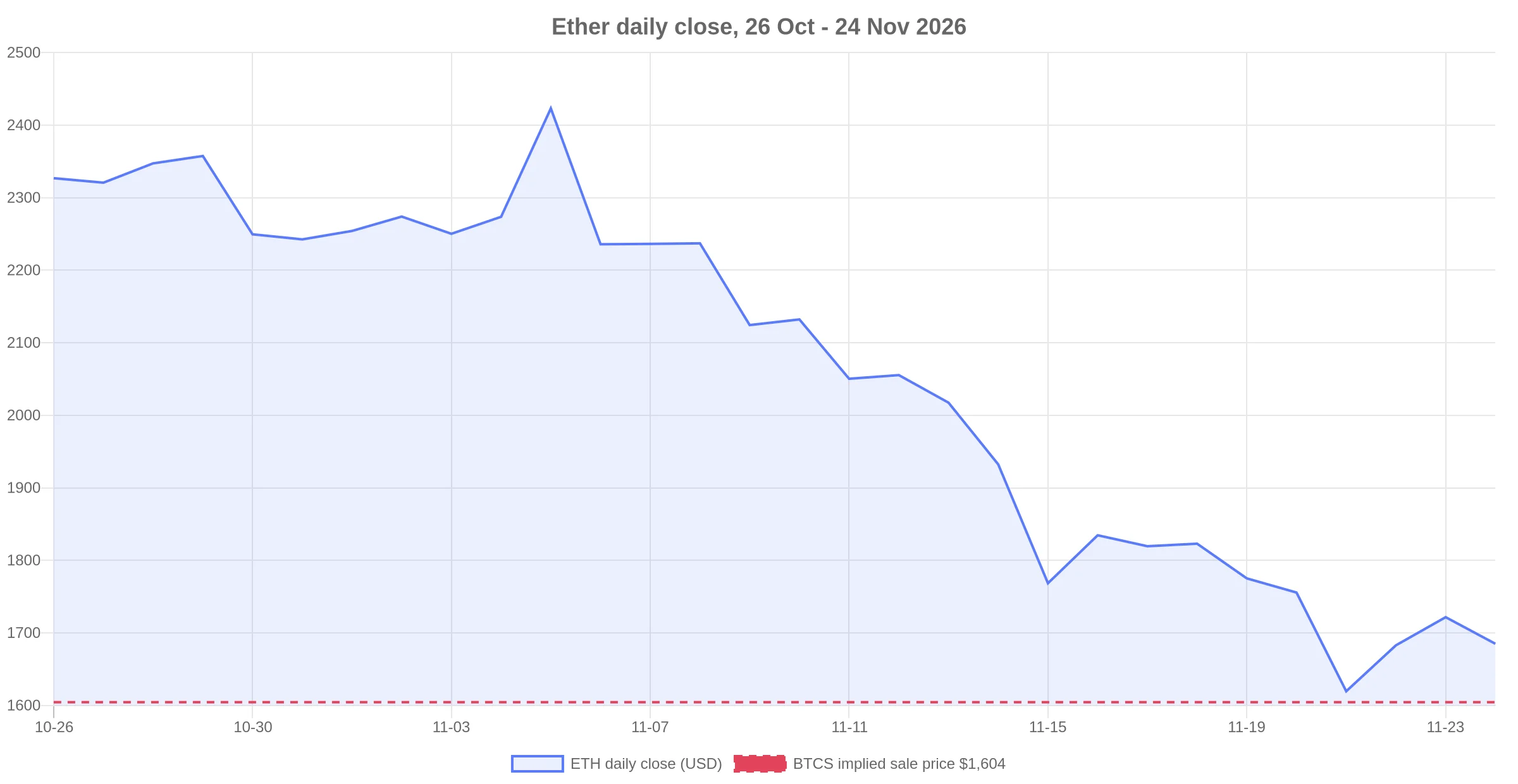
Ether daily closes, 26 October to 24 November 2026, against the $1,604 implied average sale price. Source: CoinGecko daily closes; sale price derived from the Form 8-K.
The 32% loan-to-value does not reconcile with the ether stack alone
The release says the remaining Aave position carries a loan-to-value ratio of approximately 32%. Measured against the ether the company says it still holds, the ratio comes out lower. At the $1,722 mark used in the release, 24,245 ETH is worth $41.75 million, and $10.5 million against $41.75 million is 25.1%. At today’s $1,684.94 the stack is worth $40.85 million and the ratio is 25.7%.
A 32% ratio on a $10.5 million balance implies a collateral base of about $32.8 million, roughly $9 million less than the ether stack alone is worth at the release’s own mark. Two explanations fit, and the document does not choose between them. Either part of the ether is held outside the Aave position and does not count toward that collateral figure, or the company computes loan-to-value against a narrower set of assets than its entire ETH balance. Both are ordinary; neither is stated. What can be said from the record is that the headline 32% is more conservative than the full-stack arithmetic, so it overstates rather than understates the borrowing a reader might infer.
Why a lender marks the collateral, not the story
Aave is an overcollateralized lending protocol: a borrower supplies assets, borrows against them, and the position is liquidated when the collateral value falls far enough relative to the debt. The protocol expresses that distance as a health factor, collateral value multiplied by the liquidation threshold and divided by the debt; below 1, the position becomes eligible for liquidation. The mechanics are documented at aave.com.
The release describes the pressure that made the repayment urgent. It states that on 20 November the Nasdaq Composite fell 5.3% and the S&P 500 fell 3.7%, that bitcoin traded below $60,000 for the first time since July, and that ether fell approximately 12% from its intraday high to a low of roughly $1,561. At that low, the release says, ether was down about 24% since 11 November. CoinGecko’s daily series is consistent with the scale of that move: ether closed at $2,050.34 on 11 November and at $1,619.51 on 21 November.
The company gives its own motive in the chief executive’s words, and it is worth keeping the attribution intact.
“As ETH fell, we chose to sell ETH and pay down our Aave borrowings rather than carry that debt through a falling market. Selling at these prices came at a real cost to the Company and its shareholders, and we do not take that lightly. We took these steps to reduce the risk of liquidation of our collateral, preserve our ability to meet our obligations under our senior secured convertible notes and put the Company on more durable footing.”
Charles Allen, chief executive officer of BTCS Inc., in Exhibit 99.1
What the filing does not publish is the health factor at the low, or the collateral and debt values that produced it. The distance to liquidation at the worst moment of the week therefore cannot be calculated from the record, and any claim about how close the position came would be inference rather than disclosure.
The 2027 convertibles sit behind the collateral decision
The sentence above about the convertible notes is the part of the release that turns a margin story into a capital-structure story. BTCS reports approximately $17.9 million aggregate principal of senior secured convertible notes maturing in May 2027 and July 2027, alongside the $10.5 million still owed to Aave. Total debt of $28.4 million against $61.0 million of cash and digital assets gives cover of about 2.15 times on the company’s own preliminary figures.
The notes are senior secured, which means their claim ranks ahead of other obligations and can be secured by the same assets a lender would reach. A liquidation on Aave would have consumed collateral that also stands behind those notes. The company’s stated reason for selling, preserving its ability to meet the note obligations, is consistent with that ordering, and the maturities are close enough to matter: May and July 2027 are roughly 18 and 20 months from the filing date. Nothing in the release says how the notes will be settled, refinanced or converted, and the forward-looking section flags the ability to repay or refinance them as a risk factor in its own right.
Imperium is now holding cash that earns nothing
The second half of the release concerns Imperium, the company’s decentralized finance business, which it describes as deploying capital into on-chain liquidity markets including automated market maker pools on Ethereum and Layer-2 networks. Imperium “temporarily exited its liquidity pool positions” in response to the volatility, and the release is explicit about the consequence: Imperium does not earn liquidity pool fees while its capital is undeployed.
Charles Allen framed the exit as tactical rather than terminal. “Imperium is the part of our business that performed best this year, and it is where we plan to concentrate from here,” he said, adding that the company “surpassed our full-year gross profit target in nine months on the strength of Imperium” and that it intends to redeploy “when our indicators tell us conditions have improved.”
No indicator is named, no threshold is given and no date is offered for redeployment. That leaves the company’s strongest business line sitting in cash with an open-ended return date, at the same moment its ether position has been halved. The loss of fee income is disclosed qualitatively; its size is not, and the release gives no figure for what Imperium earned from liquidity provision in the nine months it cites.
What the filing does not say
Four omissions are worth listing, because each one is a number an investor would normally want before valuing the remaining treasury. There is no realized gain or loss on the 27,300 ETH. There is no cost basis or average carrying value for the ether sold. There is no statement of whether the $61.0 million of cash and digital assets is mostly cash or mostly coins, which matters if ether keeps falling. And there is no timetable or size for further sales: the release says only that the company “may take additional actions as it considers appropriate.”
The estimates themselves carry a caveat printed in the release. They are preliminary and unaudited, have not been reviewed by the company’s independent registered public accounting firm, will change with digital asset prices and may differ from what appears in the financial statements. That is standard language for a press release issued days after an event, and it means the realized result on the sale will be struck in the next periodic report rather than in this filing. Until then, the 8-K supports the debt figure and the coin count, not the profit and loss line.
Two datapoints from the same week, pointing opposite ways
The Aave market BTCS was borrowing from was itself in motion. The same week, risk advisors proposed a set of cap changes across the protocol, including a USDC borrow cap heading toward $4 billion as 34 individual caps were cut, which is the kind of parameter work that changes borrowing costs at the margin for every leveraged position on the platform.
Corporate ether behavior also split. While BTCS was selling more than half its stack to retire debt, BitMine kept accumulating, closing in on 5% of ether’s supply as our 23 November report on that buying noted. Two listed treasuries, the same asset, opposite directions in the same week. The difference is not conviction about ether so much as the shape of each balance sheet: one company was servicing a secured loan against its coins, the other was adding to an unencumbered position.
Frequently Asked Questions
Did BTCS sell its ether at a loss?
The Form 8-K does not quantify a loss. The implied average sale price of $1,604.40 sits below ether’s 20 November close of $1,755.59 and below the $1,722 mark the company used for its post-sale balance sheet, and the chief executive says selling at these prices “came at a real cost to the Company and its shareholders.” But BTCS has not disclosed its cost basis for the ether, so a realized loss cannot be calculated from the filing alone.
How much Aave debt does BTCS still carry?
Approximately $10.5 million, down from an implied $54.3 million before the repayment, at a loan-to-value ratio of about 32% as of 22 November 2026. The company also reports about $17.9 million of senior secured convertible notes maturing in May and July 2027.
How much ether does BTCS hold now?
About 24,245 ETH, according to the preliminary and unaudited figures in Exhibit 99.1, alongside cash and digital assets with a total fair value of approximately $61.0 million at an ether price of $1,722 on 22 November. That is 52.96% of the 51,545 ETH the company held before the sale.
Why did BTCS sell ether instead of posting more collateral?
The release does not discuss adding collateral. It says the company chose to sell ether and pay down the Aave borrowings rather than carry the debt through a falling market, and it cites reducing liquidation risk and protecting its ability to meet the convertible note obligations as the reasons.
Is Imperium still trading?
The company says Imperium temporarily exited its liquidity pool positions in response to the volatility and intends to redeploy capital when its indicators suggest conditions have improved. It does not earn liquidity pool fees while that capital is undeployed, and no redeployment date or threshold has been disclosed.
This article is for information only and is not investment advice. Figures are as reported in the company’s Form 8-K and Exhibit 99.1, with market prices from CoinGecko at the timestamp stated.
About the author
Jide Idowu is a skilled freelance writer with expertise in blockchain technology, cryptocurrency, and digital finance. Known for his ability to break down complex topics into clear, engaging content, Jide crafts articles, blog posts, and analyses that resonate with both beginners and seasoned professionals. His work spans a wide range of subjects, from emerging crypto trends to in-depth explorations of blockchain innovations. With a keen eye for detail and a passion for educating readers, Jide is a reliable voice in the rapidly evolving world of digital assets.